
Compare board materials, button assemblies, RF performance and production checks when similar-looking gate remotes carry different quotes.
Reading mapArticle sections10 sections
Two suppliers quote remotes with the same housing, but one quote is higher. The useful question is what differs in the specification and delivery scope, and whether that difference matters to your installation.
The circuit board, firmware, battery contacts and button assembly may differ under a shared shell. The quotes may also include different quantities, packaging or test requirements. Appearance cannot settle any of those questions.
Start with the approved receiver model and operating conditions. A teardown can reveal construction differences; functional and environmental checks show whether they affect the result you are buying.
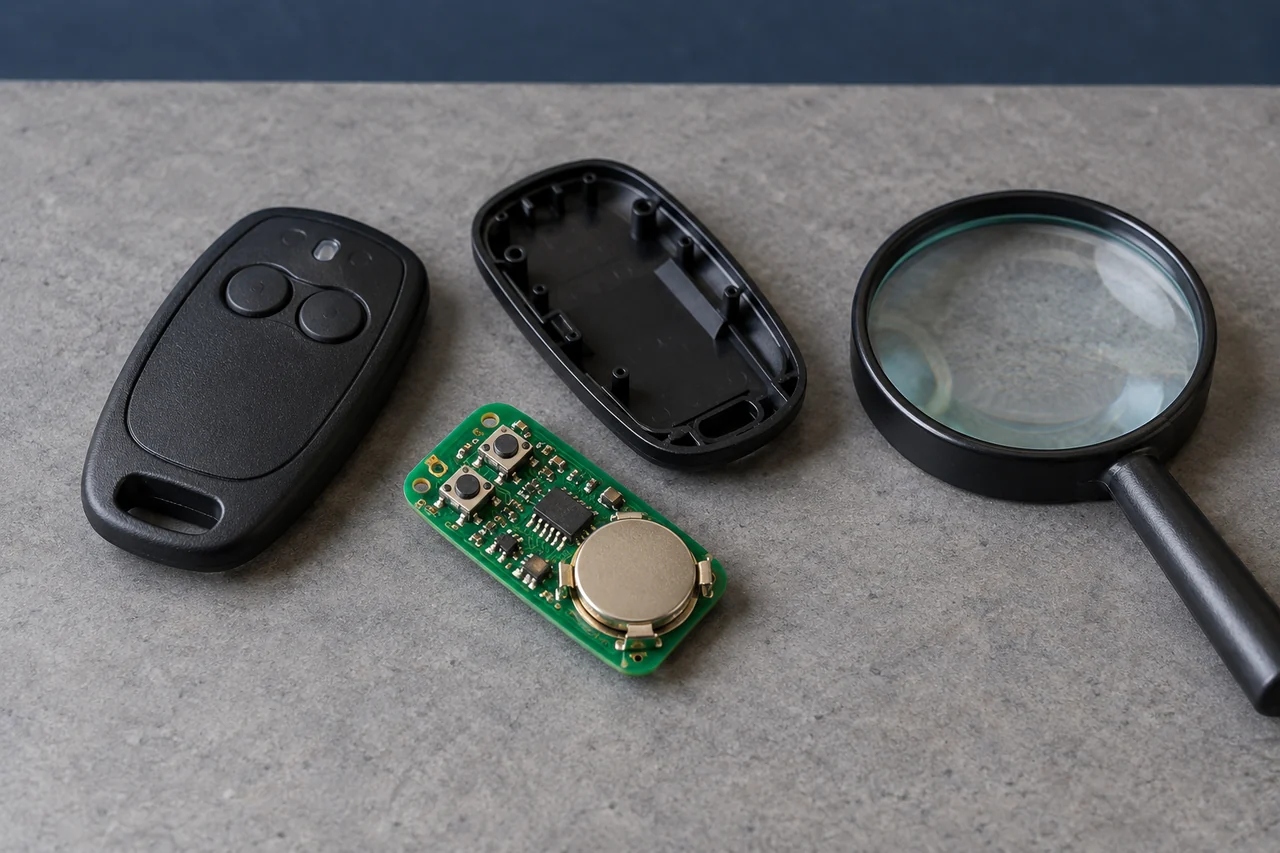
What a Shared Housing Can Hide
An existing housing can be used with more than one circuit design. Its shape tells you about size and handling, but does not identify the radio protocol or the parts inside.
Ask each supplier for the exact product revision, compatible receiver list and included battery and accessories. Two offers become comparable only when those details match.
A PCB photograph helps check component placement and obvious assembly defects. It cannot establish firmware behavior, component authenticity or service life.
Treat missing parts or a changed board as questions to investigate against the approved design. A lower price alone is no evidence of recycled components, omitted protection or deliberate substitution.
- Compare the PCB drawing and material specification with the approved revision.
- Check component part numbers and permitted alternatives against the bill of materials.
- Identify the firmware version and the receiver models used for validation.
- Compare inspection coverage and final test limits, including how failures are handled.
PCB Material: Specify the Grade
FR-4 and paper phenolic describe different laminate families. Board thickness, material grade, mechanical support and exposure conditions all matter. A photograph or a yellow, brown or green surface is not enough to identify the laminate.
Paper phenolic is not automatically unsuitable for a remote. Panasonic lists remote controls among the applications for its R-8700 family. That is a reason to check the specified grade and its limits, rather than reject every paper-based board.
FR-4 is also not one uniform performance specification. Isola's FR406 datasheet gives properties and test methods for a particular laminate. Use the actual supplier datasheet when comparing heat resistance, moisture behavior and mechanical properties.
Choose the board material for the assembly process and intended environment, then verify the finished remote. A laminate claim does not prove that the housing keeps out water or that the assembled product survives a drop.
Range Changes When the Remote Is Held
If range changes with grip or orientation, repeat the observation with the case assembled and a fresh battery. Compare normal hand positions at the same receiver location.
The housing and a user's hand can change antenna impedance and efficiency. Texas Instruments shows this effect in its antenna matching guide. The size of the change depends on the antenna and surrounding materials; it is not a price-based defect diagnosis.
The layout and matching network need to suit the assembled product. Ask for results measured with the intended housing, battery and normal grip, rather than relying on an exposed PCB demonstration.
If two remotes behave differently, record success counts and orientation before changing components. This gives the supplier a reproducible symptom to investigate.
Check Buttons as an Assembly
Button performance depends on the switch or dome, the housing actuator, PCB support and firmware debounce. A soft or inconsistent feel may come from alignment as well as the contact itself.
Check every button for missed commands, repeated commands and sticking. A crisp click at sample approval tells you little about what happens after repeated use.
Switch life claims belong to a particular part and test conditions. Omron's B3F documentation distinguishes models and contact options. Request the part number and relevant rating, then verify the complete button assembly under your intended use.
- Compare operating force and return behavior across all keys.
- Ask for the switch or dome part number and the life-test conditions.
- Check missed or repeated commands before and after the agreed durability test.
- Inspect actuator alignment and PCB support in assembled samples.
What SMT and AOI Actually Check
A repeatable design still needs a controlled assembly process. The evidence to request is the inspection criteria, results and response to defects.
An SMT line can place components consistently, but equipment ownership does not prove the stencil, soldering profile or inspection program is correct for this board.
Automated optical inspection examines visible component and solder geometry. Omron describes AOI and X-ray inspection as parts of process quality control. These inspections do not establish that a remote sends the correct protocol or pairs with your receiver.
Ask which defects the line checks, who reviews flagged boards and what happens after rework. A list of machines is less useful than a traceable pass or fail record.
When Environmental Protection Is Needed
Conformal coating should be a design decision based on exposure, not an assumed feature of a higher-priced remote.
A handheld remote kept indoors has different exposure from one left in a vehicle or used near salt spray. Define storage and operating conditions separately.
Coating suppliers such as MG Chemicals describe protection against moisture and contaminants. That does not establish an ingress rating for the complete remote. Seams, buttons and battery openings still need to be considered.
If coating is specified, ask for the material, covered areas, application and cure controls. Verify that battery contacts and button mechanisms still work, and test the finished product under the agreed exposure.
Define the Final Functional Test
Separate production screening from qualification tests. A short test can screen every unit for basic faults; extended range, drop and environmental tests need their own sampling plan and acceptance criteria.
For production screening, specify every button's response, radio frequency and output checks, current draw and decode behavior. Include actual receiver pairing where it is necessary to verify the delivered configuration.
Record the equipment or fixture, limits and product revision. A pass light is meaningful only if the test would detect the faults you are trying to prevent.
Compare Total Cost with Evidence
Add the costs you can establish: delivered units, tooling or setup charges, packaging, freight and the agreed warranty or replacement terms.
Keep assumptions visible when estimating support costs. Use your return history and cost per case; do not invent a failure rate to justify either quote.
A replacement may involve handling, diagnosis and shipping as well as the unit itself. Which of these costs applies depends on your sales channel and service agreement.
A higher price may be worthwhile if the supplier provides a required specification or better verified performance. Without that evidence, the price difference remains unexplained.
What to Ask Before Approval
- Request the exact receiver compatibility list and product revision.
- Obtain the laminate grade and key component part numbers.
- Review range results with the finished housing, battery and normal grip.
- Agree button durability and environmental checks for the intended use.
- Review inspection coverage, final test limits and rework handling.
- Retain a signed sample and the specification it represents.
- Check production samples against that reference and require notice of relevant changes.
Investigate Failures Against the Approved Product
When a batch develops faults, group the symptoms first: pairing failures, short range, missed button presses or damaged contacts. A single label such as poor quality can hide different causes.
Compare failed units with working units from the same batch and with the retained sample. Record board revision, visible changes and the conditions that reproduce the fault.
A shared shell tells you what fits in the hand. Approval needs a specification and results from the assembled remote.
Send the supplier the failed samples, observations and agreed limits. A teardown can guide the investigation, but the repair or replacement decision should follow evidence of the fault and the purchasing agreement.

About the Author
Eric Huang
RF Remote Controls & Controllers Specialist
I work with trade buyers on custom RF remote and controller projects, automotive remote requests and aftermarket gate and garage remote sourcing. These guides help you define product requirements and plan sample checks before ordering.
Share your application or original system, target market and question to discuss the next steps.
Keep reading
Related articles
What to Compare in an RF Remote Wholesale Quote
Separate electronics, parts, production checks and market documentation from one-time charges before comparing RF remote unit prices.
Read next TroubleshootingDiagnose Short Range on a 433 MHz Remote
Use controlled substitutions and supply, antenna and decoding checks to find why a remote works at one installation but fails at another.
Read next RF EngineeringBuild a Low-Voltage RF Remote with Matched Modules
Choose a matched transmitter and decoded receiver, check the control interface, and test one low-voltage load before adding more functions.
Read nextDiscuss Your Project or Replacement
Share your application or original system and your question to discuss the next step.
RF questions by email
Ask Eric About Your Remote or Receiver
Describe your remote or receiver, the issue and what you have already tried. Add model details and your country if available.
Opens a draft in your email app. Review it, attach any photos and send your message.