
Separate electronics, parts, production checks and market documentation from one-time charges before comparing RF remote unit prices.
Reading mapArticle sections7 sections
Two remotes with similar housings can arrive with different wholesale quotes. Before judging the gap, check whether the offers cover the same receiver compatibility, quantities, materials, tests and delivery terms.
A unit price without that scope is difficult to compare. One offer may include batteries and packaging; another may leave them out or spread development costs over a different order quantity.
There is no reliable rule that the chip is always the largest cost or that the higher-priced remote is more dependable. Ask for the specification and the identifiable items behind the quote.
The useful comparison has four parts: electronics and firmware, physical parts, production and verification, and market-specific documentation. Separate recurring unit cost from tooling and other one-time charges.
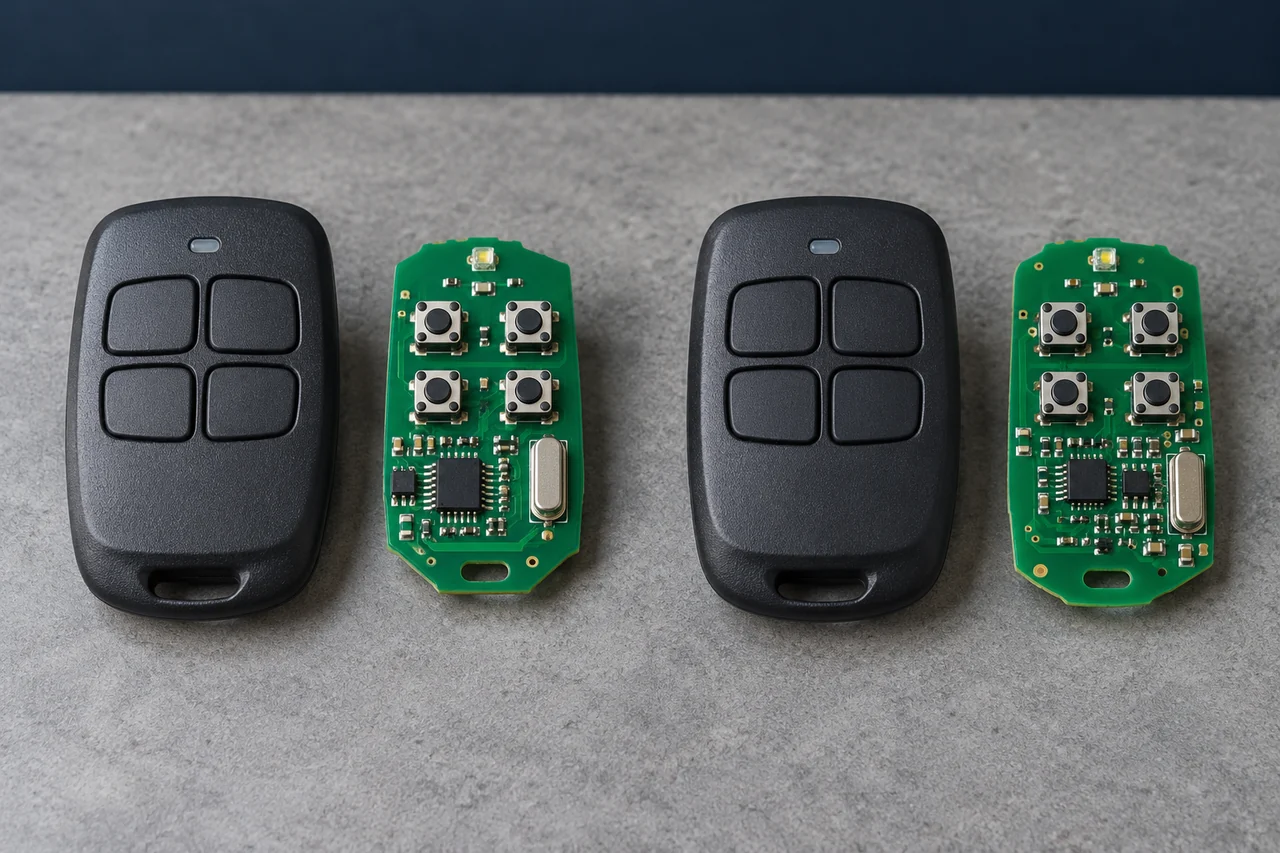
Electronics: Compare the Required Function
The encoder, RF circuit and firmware should be selected for the receiver and application. A cheaper chip that cannot enroll with the installed receiver is not a substitute for the required one.
A static-code design sends a repeated identifier. It can be suitable for some control tasks, but should not be priced or marketed as though it provides authenticated freshness.
The term learning code often describes a receiver storing a transmitter ID. It does not establish encryption, a changing code or broad copy-device compatibility. Have the supplier define what it means for the offered product.
The HCS301 datasheet describes an encrypted hopping code and keys, serial number and configuration programmed during production. For an offer based on that device, ask who manages production programming, how the required configuration is controlled and which receiver family was tested. If a separate MCU is used, identify its firmware revision as well.
Do not assume a fixed multiple between static and rolling-code costs. The quoted cost depends on the part, quantity, supply terms, programming work and the rest of the assembly.
RF Architecture: Compare the Complete Circuit
A handheld one-way transmitter does not need a receiver. Comparing its price using super-regenerative versus superheterodyne receiver architecture mixes two different products.
An integrated transmitter can combine functions that otherwise need separate parts. Microchip's MICRF112, for example, uses a crystal reference and PLL with an RF power amplifier. That changes the component list; it does not by itself prove lower cost or better assembled-product performance.
For a transmitter, compare frequency stability, supported modulation, supply limits and assembled RF results. For a transmitter-and-receiver kit, price and evaluate both ends separately.
Materials: Ask for Grades and Ratings
Parts can differ in dimensions, tolerances and environmental limits. Record the specified part or material grade rather than treating premium as a measurable property.
For the oscillator, request frequency tolerance over the required voltage and temperature range. SAW, crystal and LC describe implementations; none is an automatic quality grade for the finished remote.
A room-temperature frequency check is useful screening, but it cannot establish operation across the whole environmental range. Ask for the conditions used in qualification and for any limits on battery voltage.
PCB material needs the same treatment. Panasonic lists paper phenolic laminates for remote-control applications. FR-4 can also be specified, but the correct comparison is between known grades and required properties, not board colour or a blanket ranking.
Compare the PCB finish with the soldering process and contact design. A finish intended for solder pads should not be assumed to solve wear on exposed button or battery contacts.
For the housing, request the resin grade and the relevant strength, aging or flammability requirement. Recycled content alone does not establish brittleness, just as a virgin-material claim does not prove the housing passes a drop test.
For buttons, the switch or dome rating, actuator alignment and PCB support all matter. Confirm the conditions behind a life claim and test the finished assembly, rather than predicting failure from its price.
- Specify oscillator tolerance and test conditions.
- Identify the laminate grade, thickness and PCB finish.
- Record housing material and the mechanical checks required.
- Identify the switch or dome and button life-test conditions.
- Require approval for relevant substitutions to the agreed parts.
Production: Pay for Defined Checks
Assembly and inspection add labor, equipment time and fixtures. Ask what those activities actually check and whether they are included in the price.
Automation can improve repeatability, but a controlled manual process can also be appropriate. Equipment photographs do not establish the soldering settings or acceptance limits used for your order.
Omron's inspection documentation describes AOI and X-ray checks of solder geometry. They help control assembly defects; they do not replace a functional check that the required button sends a message the receiver accepts.
Separate production screening from design qualification. Every-unit button and transmit checks have a different scope and cost from sampled environmental or durability testing.
An RF fixture can screen frequency and output under defined conditions. A controlled range test checks the finished link. Agree the limits, sample plan and record format instead of accepting tested as a complete specification.
Ask how reworked units are inspected again and how test records identify the batch. Higher test expenditure is useful only if the chosen checks address a requirement or a known fault.
Market Requirements: Price the Actual Variant
A wholesale quote should identify the destination market and the exact hardware configuration covered by its documentation.
Changing the band can change the reference oscillator, matching parts and antenna. It can also change the applicable radio requirements. A configurable listing is not evidence that every selectable setting is covered.
For EU sales, the Radio Equipment Directive provides the framework for radio-equipment conformity. CE marking is not one universal laboratory certificate. Ask for the applicable declaration and technical evidence for the offered model.
For each destination, have the responsible party identify the required assessment and documents. Agree who pays for testing, labels, instructions and evaluation of later changes; do not assume an unrelated report covers a rebranded or modified product.
Questions that Clarify a Quote
Does one frequency cost more? Ask what changed in the offered design and assessment scope. Frequency alone does not establish which quote should be higher.
What does supplier experience establish? Request a relevant test record, supported receiver list and change history. A claimed number of years does not prove that the current revision meets your specification.
What can visual inspection establish? Check seams, button alignment, contacts and obvious solder defects. Appearance can reveal a problem to investigate, but cannot prove RF compatibility, security or long-term reliability.
Compare the Delivered Cost
Include unit price, order quantity, packaging, batteries, setup charges, tooling, freight and applicable tax or duty. Keep one-time and recurring charges separate so a later order is comparable.
For support costs, use your own return history, handling time and replacement terms. If those records are unavailable, show the assumption instead of assigning the cheaper offer a fictional failure rate.
Approve the least costly offer that meets the required scope with adequate evidence. A higher quote may include useful work, unnecessary features or simply a different commercial margin; ask which it is.
A price gap needs an explanation tied to the specification, delivery terms or verification work. It does not supply that explanation on its own.
For a comparable quote, send the receiver models, required functions, destination, quantity, operating conditions and acceptance checks. Ask suppliers to identify exclusions and assumptions alongside the price.

About the Author
Eric Huang
RF Remote Controls & Controllers Specialist
I work with trade buyers on custom RF remote and controller projects, automotive remote requests and aftermarket gate and garage remote sourcing. These guides help you define product requirements and plan sample checks before ordering.
Share your application or original system, target market and question to discuss the next steps.
Keep reading
Related articles
Diagnose Short Range on a 433 MHz Remote
Use controlled substitutions and supply, antenna and decoding checks to find why a remote works at one installation but fails at another.
Read next RF EngineeringReceiver Sensitivity: Compare the Test Conditions
Read a sensitivity figure with its waveform, bandwidth and error target, then test whether receiver performance is limiting the installed link.
Read next Buyer ChecklistEU CE Requirements for Wi-Fi Switches: Product, Evidence and Responsibility
Identify the EU rules for the actual Wi-Fi switch, including RED safety and EMC, RoHS, documentation and the current RED-to-CRA cybersecurity timeline.
Read nextDiscuss Your Project or Replacement
Share your application or original system and your question to discuss the next step.
RF questions by email
Ask Eric About Your Remote or Receiver
Describe your remote or receiver, the issue and what you have already tried. Add model details and your country if available.
Opens a draft in your email app. Review it, attach any photos and send your message.