
Identify the EU rules for the actual Wi-Fi switch, including RED safety and EMC, RoHS, documentation and the current RED-to-CRA cybersecurity timeline.
Reading mapArticle sections10 sections
A CE mark declares conformity for a defined product. The supporting evidence must describe the product that is actually shipped.
A supplier's document headed CE certificate is not enough to assess a Wi-Fi switch. Ask which model, hardware revision and firmware it covers, which legislation applies and how conformity was assessed.
The radio module's documents can support part of the assessment. They do not automatically cover the finished switch's wiring, load current, enclosure, antenna arrangement or software configuration.
A mains-powered switch needs attention to the switched circuit as well as the wireless link. Electrical safety and EMC remain part of the radio-equipment assessment.
The file also needs a responsible manufacturer, an EU Declaration of Conformity, identification and instructions matched to the product.
Connected products add questions about internet capabilities, processed data, security functions and updates. These cannot be answered from an RF spectrum report alone.
This guide describes the EU framework as checked on 5 October 2026. Product scope, intended use and the current standards listing still determine the assessment for a particular model.
Start by collecting the product specification and existing evidence. That makes a gap review more useful than ordering a generic CE testing package.
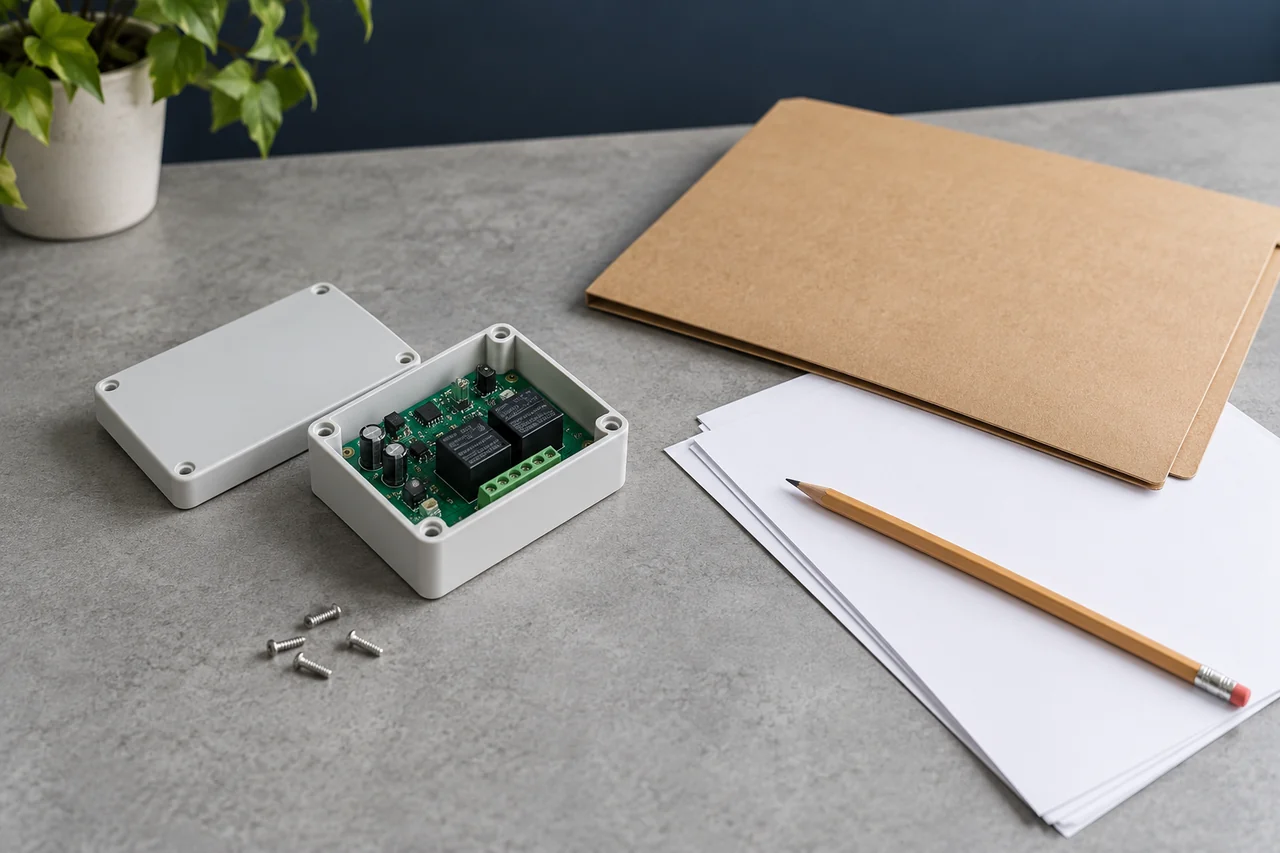
CE Marking Is a Declaration Supported by Evidence
The manufacturer identifies the applicable legislation, performs the required conformity assessment, prepares technical documentation and draws up the EU Declaration of Conformity before applying the CE mark.
A lab test report records an assessment of specified samples under specified conditions. A notified body's certificate may also be needed for a selected conformity route. Neither replaces the manufacturer's obligations.
The assessment must address the product's intended use and reasonably foreseeable risks. Keep the findings, design evidence and relevant test reports with the technical documentation.
A recognizable mark or a marketplace's acceptance of uploaded files does not prove that the evidence covers the final model.
RED Covers the Radio Switch's Safety, EMC and Spectrum
A finished switch that intentionally communicates by Wi-Fi is normally radio equipment under Directive 2014/53/EU. RED covers safety and health, electromagnetic compatibility and efficient spectrum use.
- RED safety: Article 3(1)(a) incorporates the LVD safety objectives with no voltage limit. Low supply voltage does not remove a radio product from that requirement.
- RED EMC: Article 3(1)(b) covers electromagnetic compatibility. For radio equipment within RED, LVD and the EMC Directive do not apply separately; do not automatically list all three as parallel directives for the same switch.
- RoHS: Directive 2011/65/EU restricts specified substances in electrical and electronic equipment, subject to scope and exemptions; its evidence also forms part of the CE assessment.
- WEEE: waste-equipment marking, registration and producer responsibilities are separate obligations, not another CE laboratory test.
For RED's relationship with the electrical directives, see the Commission's RED implementation report. Separately supplied equipment, such as an external power supply, may have its own applicable legislation and assessment.
Labels, Instructions and the EU Economic Operator
Prepare the product label and instructions alongside the design. These are required product information, not documents to improvise after a test report arrives.
- Keep model, batch or serial identification and the manufacturer information consistent with the declaration and shipped product.
- Provide instructions and safety information in the language or languages required by the Member State of sale.
- Identify the importer and the applicable EU-established economic operator; check their required markings rather than assuming one address satisfies every role.
- Review WEEE registration, reporting and financing duties for the actual producer role and countries of sale.
- Assess relevant REACH substance-information and packaging obligations for the product and distribution route.
Article 4 of Regulation (EU) 2019/1020 requires an EU-established operator for covered products. The role may be an EU manufacturer, importer, mandated authorised representative or, where none of those is established in the EU, a qualifying fulfilment service provider. It is not simply a paid contact address.
Cybersecurity: The Rules in Force in October 2026
Delegated Regulation (EU) 2022/30, as amended, has applied since 1 August 2025. The Commission has also published Regulation (EU) 2026/339, but its repeal of 2022/30 takes effect on 11 December 2027. The RED cybersecurity requirements activated by 2022/30 therefore still apply to equipment in scope on the date of this guide.
Article 3(3)(d) covers the internet-connected radio equipment defined by the act, including communication through other equipment. Article 3(3)(e) applies to specified categories capable of processing personal, traffic or location data; internet-connected equipment is one of those categories. Article 3(3)(f) concerns internet-connected equipment enabling money, monetary-value or virtual-currency transfers. Evaluate those capabilities and the act's exclusions instead of assuming all three apply to every switch.
The Cyber Resilience Act has a separate phased timeline. For manufacturers and products within its scope, reporting duties for actively exploited vulnerabilities and severe security incidents began on 11 September 2026. Its main product obligations apply from 11 December 2027. A current RED review and preparation for the CRA are both relevant; the CRA is not yet fully applicable.
Check the Assessment Route and Standards
A standard number tells you which technical method was used. Ask for the edition, covered requirements, tested operating modes and any exclusions. A standard or report does not provide a universal CE certificate.
EN 18031-1, -2 and -3:2024 address different RED cybersecurity requirements. Their Official Journal references include restrictions, including password-related limitations. Applying a named part without checking those restrictions may leave a gap in the presumption of conformity.
RED Article 17 permits different conformity procedures. For Article 3(2) and relevant Article 3(3) requirements, not applying the cited harmonised standards in full, or lacking such standards, requires the Annex III or Annex IV route for those requirements, with notified-body involvement.
For safety and EMC, choose standards relevant to the switch, loads and intended environment. Do not assume a module's radio report covers the mains circuit or the complete product's immunity and emissions.
Use the current Official Journal references and transition dates when the product is assessed. A report against an older edition needs review; it is neither automatically unusable nor automatically sufficient.
Define the Product before Commissioning Tests
Give the assessor a complete specification and a representative sample. Missing functions or accessories can lead to an assessment scope that is too narrow.
- Product boundary: wall switch, plug, receiver, module or equipment assembly; list any separately supplied power equipment.
- Electrical design: supply, wiring method, switched loads, protection and installation conditions.
- Radio design: every supported band, mode, antenna and simultaneous operating combination.
- Software and data: internet communication, accounts, data handled, security functions and update mechanism.
- Commercial roles: brand owner, legal manufacturer, importer and EU distribution countries.
Agree which existing evidence can be reused and what finished-product assessment remains. Record the reasons rather than assuming that a pre-assessed module removes the need for product-level work.
Related Products May Follow Different Legislation
A product name such as smart switch does not determine the complete legal scope.
- Mechanical switches without radio: assess their product category, intended use and applicable electrical-product rules rather than copying a Wi-Fi file.
- Wired electronic switches without radio: evaluate applicable LVD and EMC scope for the actual equipment, including voltage limits and exclusions.
- Wi-Fi switches and plugs: assess the finished radio equipment under RED and any other applicable legislation, including RoHS.
- Products with several radios: include each mode and relevant simultaneous operation; one radio's report does not establish conformity of the whole combination.
RoHS currently restricts ten substances. Supporting evidence needs to cover the product's relevant materials and components; verify any claimed exemption and its applicability rather than relying on a general supplier logo.
Review the File against the Shipped Version
Use a release review that links evidence to identifiers and configuration. It should make missing or mismatched items visible.
- Applicable legislation and product-scope decisions are recorded.
- Risk assessment, design records and relevant test evidence describe the finished configuration.
- The EU Declaration of Conformity identifies the product and applicable acts, and is signed for the responsible manufacturer.
- Model identification, CE marking and required manufacturer/importer/operator details appear in the required locations.
- Instructions cover installation, intended loads, operation and required safety information in the destination languages.
- WEEE marking and relevant national producer obligations have been addressed.
- Any applicable RED cybersecurity assessment and current CRA reporting arrangements are identified.
- Changes to firmware, antennas, enclosure, components or loads are reviewed for their effect on conformity.
WEEE marking and producer responsibilities need their own country-specific review. The crossed-out wheelie bin is not a substitute for registration, reporting or financing arrangements.
Allocate Responsibilities by Legal Role
The manufacturer is responsible for product conformity. A business that has a product made and markets it under its own name or trademark can be the manufacturer even when another company assembles it.
Importers and distributors have their own duties to verify required conformity, identification and information. An authorised representative acts within a written mandate; using a lab or representative does not erase the other parties' responsibilities.
Assign who retains the records, answers authority requests and reviews product changes. Under RED, the manufacturer keeps the technical documentation and declaration for ten years after the equipment is placed on the market.
A useful compliance file lets another reviewer identify the product, the applicable requirements and the evidence for each assessment.
Official References to Keep with the Review
- European Commission CE guidance: manufacturer declaration and the supporting assessment.
- RED 2014/53/EU: product scope, essential requirements and conformity procedures.
- 2022/30 as amended, and 2026/339: current cybersecurity scope and repeal effective on 11 December 2027.
- Decision 2025/138 and the current harmonised-standard listings: EN 18031 references and restrictions.
- European Commission CRA guidance: reporting from 11 September 2026 and main obligations from 11 December 2027.
- RoHS, WEEE and Regulation 2019/1020 guidance: materials, waste-equipment duties and the EU economic-operator role.

About the Author
Eric Huang
RF Remote Controls & Controllers Specialist
I work with trade buyers on custom RF remote and controller projects, automotive remote requests and aftermarket gate and garage remote sourcing. These guides help you define product requirements and plan sample checks before ordering.
Share your application or original system, target market and question to discuss the next steps.
Keep reading
Related articles
OEM or ODM for RF Remotes: Define the Scope
Compare who designs, who owns the results, how changes are approved and what evidence is delivered before choosing an OEM or ODM arrangement.
Read next RF EngineeringRF Transmitter Modules: Check Output and Repeatability
Compare carrier accuracy, matching, unwanted emissions and sample variation under the conditions the finished remote must meet.
Read next RF EngineeringRF Remote Collisions: Check the Hardware and Protocol
Separate one-way repetition from receive-capable channel sensing and two-way acknowledgments, then test command overlap and duplicate handling.
Read nextDiscuss Your Project or Replacement
Share your application or original system and your question to discuss the next step.
RF questions by email
Ask Eric About Your Remote or Receiver
Describe your remote or receiver, the issue and what you have already tried. Add model details and your country if available.
Opens a draft in your email app. Review it, attach any photos and send your message.