
Separate one-way repetition from receive-capable channel sensing and two-way acknowledgments, then test command overlap and duplicate handling.
Reading mapArticle sections11 sections
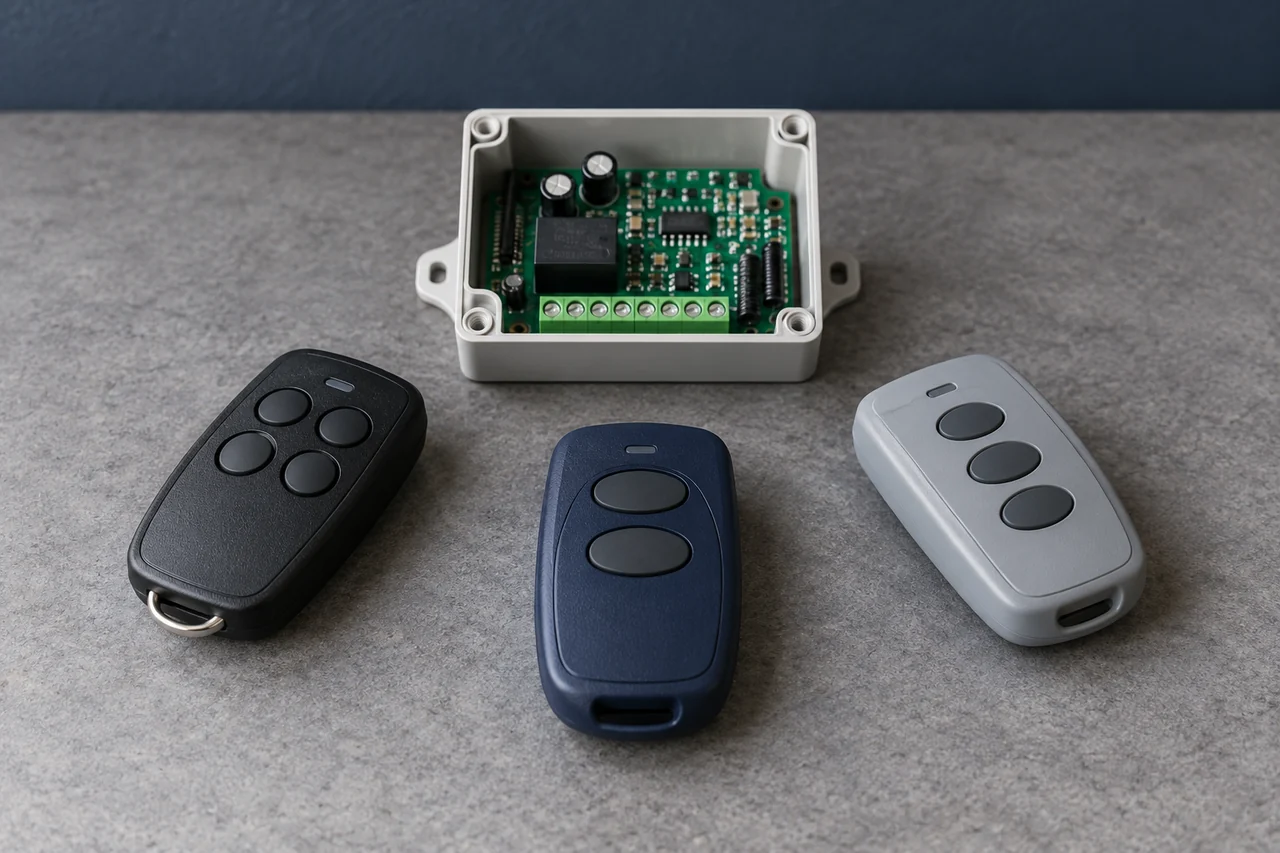
A different remote address does not reserve a different radio channel.
Two remotes may work separately and miss commands when pressed together. Before changing code or transmit power, check whether their frames overlap at the receiver.
Receivers respond to signals arriving within their bandwidth, including traffic intended for other devices. Address checking happens after enough of a frame has been recovered; it does not prevent RF overlap.
The available remedy depends on hardware. A transmitter-only handheld cannot listen for a clear channel or receive an acknowledgment. A transceiver can support those functions if the protocol implements them.
What Happens at the Receiver
Radio waves do not crash into one another in the air. They superimpose at the receive antenna; the receiver must recover its wanted waveform from the combined input.
A simplified signal-quality measure is SINR = S/(I + N), with desired signal S, interference I and noise N expressed as linear powers at the same reference point and bandwidth. Do not add dBm values in this equation.
Overlapping traffic can corrupt a frame, but not every overlap loses both signals. A stronger signal may be captured, depending on the receiver, timing, modulation and power difference.
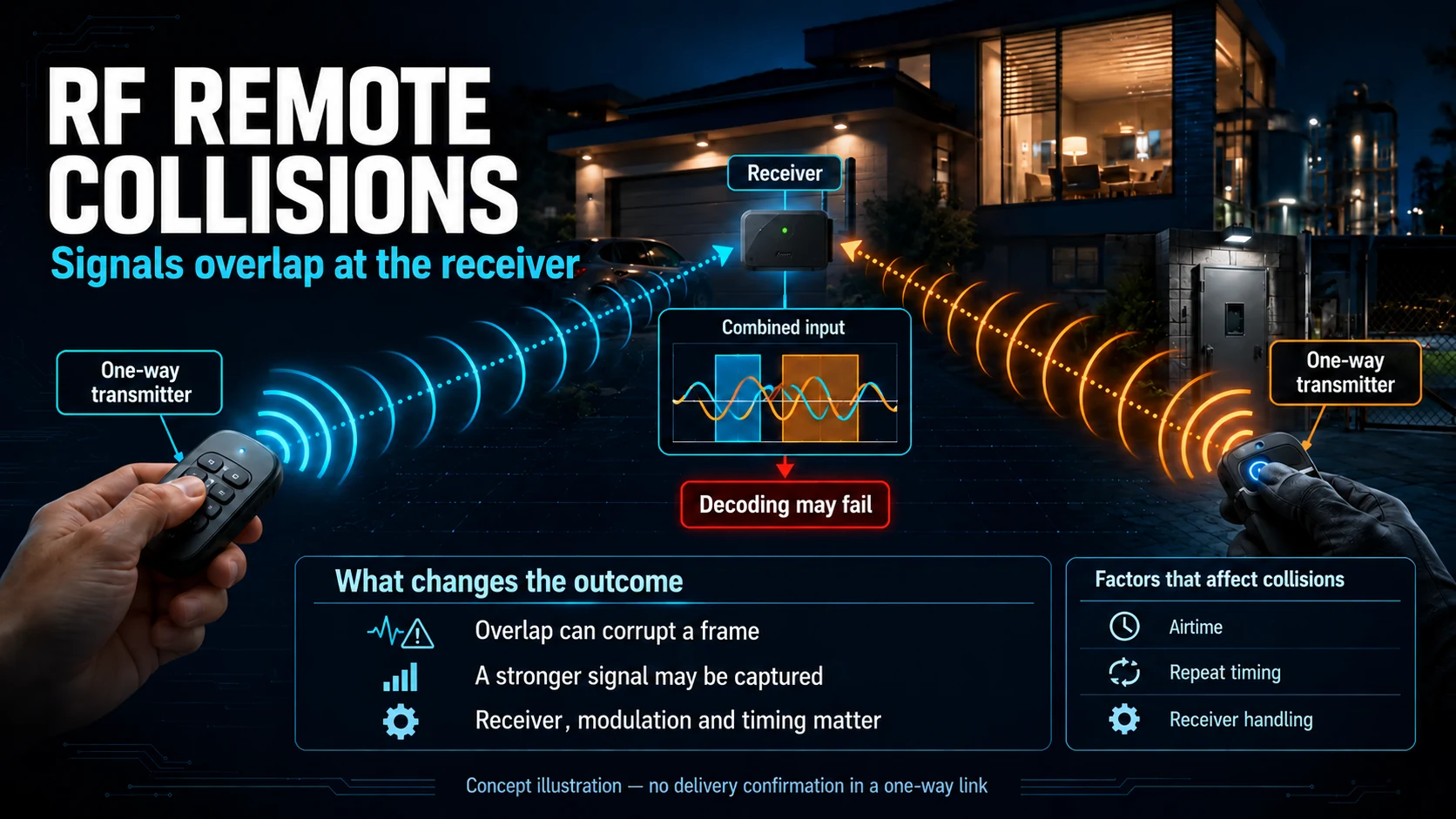
- Co-channel overlap: transmissions arrive within the same receive channel during overlapping time. Different addresses do not avoid it.
- Adjacent-channel or out-of-band interference: filtering, transmitter spectrum and receiver dynamic range can allow nearby-frequency signals to impair reception.
- Hidden nodes: two transmitters cannot hear each other but both reach one receiver. Even a listening transmitter can therefore decide its local channel is clear while a collision occurs elsewhere.
Define the Consequence of a Missed Command
For a simple light-control remote, a retry may be acceptable. Specify the required response time and how the user knows whether the command took effect.
For moving machinery or access equipment, radio loss has to be handled by the complete control system. Define the safe state, timeout and permitted recovery with the equipment requirements.
A hobby radio protocol does not become safety-rated by adding ACKs. Verify the controller’s behavior after missing, delayed, repeated or out-of-order commands as well as its independent safety functions.
Choose Coordination the Hardware Can Support
Frequency separation, time scheduling, hopping, spreading and carrier sensing solve different parts of coexistence. They are not interchangeable firmware options for a fixed-frequency transmitter-only remote.
- FDMA: assign separate frequency channels and provide enough receiver selectivity.
- TDMA: assign transmit windows with synchronization and guard time.
- FHSS: coordinate frequency changes between compatible radios.
- DSSS: use a spreading code and matched receiver processing; spreading alone does not schedule access.
- CSMA/CA: sense the channel and use a defined contention/backoff procedure. Sensing requires a receiver in the transmitting node.
Frequency Separation Needs Receiver Support
Separate channel centers can reduce overlap when occupied bandwidth, frequency tolerance and guard spacing are appropriate. The receiver must be able to receive the channels assigned to its transmitters.
The EU SRD decision includes the 433.05–434.79 MHz range with conditional power and duty entries. It is not an unrestricted pool of independently usable channels; check the applicable entry, equipment rules and national implementation.
A single receiver tuned to one channel does not automatically receive several channels at once. Concurrent multi-channel reception may require separate receivers or a different architecture.
Time Slots Need Synchronization
TDMA gives each participating node a transmit window. Guard intervals account for clock error and switching time, and the receiver must know when to listen.
A schedule can bound access delay within the managed network. It does not exclude unrelated radios using the same spectrum or make successful reception deterministic under interference.
Clock drift increases timing uncertainty between synchronizations. The design needs an appropriate synchronization method and recovery after reset or missed timing information; a transmitter-only remote may not be able to receive scheduling beacons.
Hopping Requires Matched Radios
FHSS changes the operating channel according to an agreed sequence. Both ends need frequency-agile hardware and enough synchronization to meet on the same channel.
A hop can move later packets away from narrowband interference, but a packet lost on one hop is still lost unless the protocol recovers it. Wideband interference or several occupied channels can affect many hops.
Adaptive channel selection needs a way to measure conditions and coordinate the changed sequence. Hopping must also fit the spectrum and access rules for the selected market.
Spreading Does Not Guarantee Separation
DSSS maps data to a faster chip sequence and uses matched despreading at the receiver. It can improve tolerance to some interference when its processing assumptions are met.
The bandwidth, synchronization and receiver implementation determine the result. Multiple spreading codes are not automatically collision-free, particularly when received powers differ greatly.
Listen Before Transmitting
Carrier sensing or clear channel assessment, CCA, lets a receive-capable node estimate whether a channel is busy. The threshold, observation time and decision method affect which signals it notices.
TI’s CC1101 supports CCA for listen-before-talk. A complete contention protocol must still define wait/backoff and retry behavior. ACK-based retries additionally require a return transmission and receive capability at both ends.
Two nodes can sense a clear channel together and then transmit together. Hidden nodes and interference that begins after sensing remain possible. CCA lowers some collision risk; it does not guarantee access or delivery.
Specify Retries, Latency and Power Together
For a transmitter-only product, bounded repeated frames can give another chance after a brief overlap. Randomized timing can reduce persistent repeat overlap if the protocol and duty rules allow it, but the remote still has no delivery confirmation.
Repeated commands need receiver duplicate handling. Otherwise one press can become multiple toggle actions. Define whether repeats represent the same command, a held key or a new event.
For a two-way protocol, bound the retry count, delay and total command age. A late command delivered after several retries may no longer be useful.
Listening and waiting for ACKs consume energy too. Measure the entire transaction, including wake-up, receive windows and unsuccessful retries, with the intended traffic.
Frequency, Coding and Channel Access Are Separate Choices
A simple 433 MHz remote can be one-way, but the frequency does not require that architecture. Sub-GHz transceivers also support packet handling, channel assessment and frequency agility.
Rolling code changes authentication and replay handling. It does not prevent two radios from transmitting at once and does not inherently improve interference rejection.
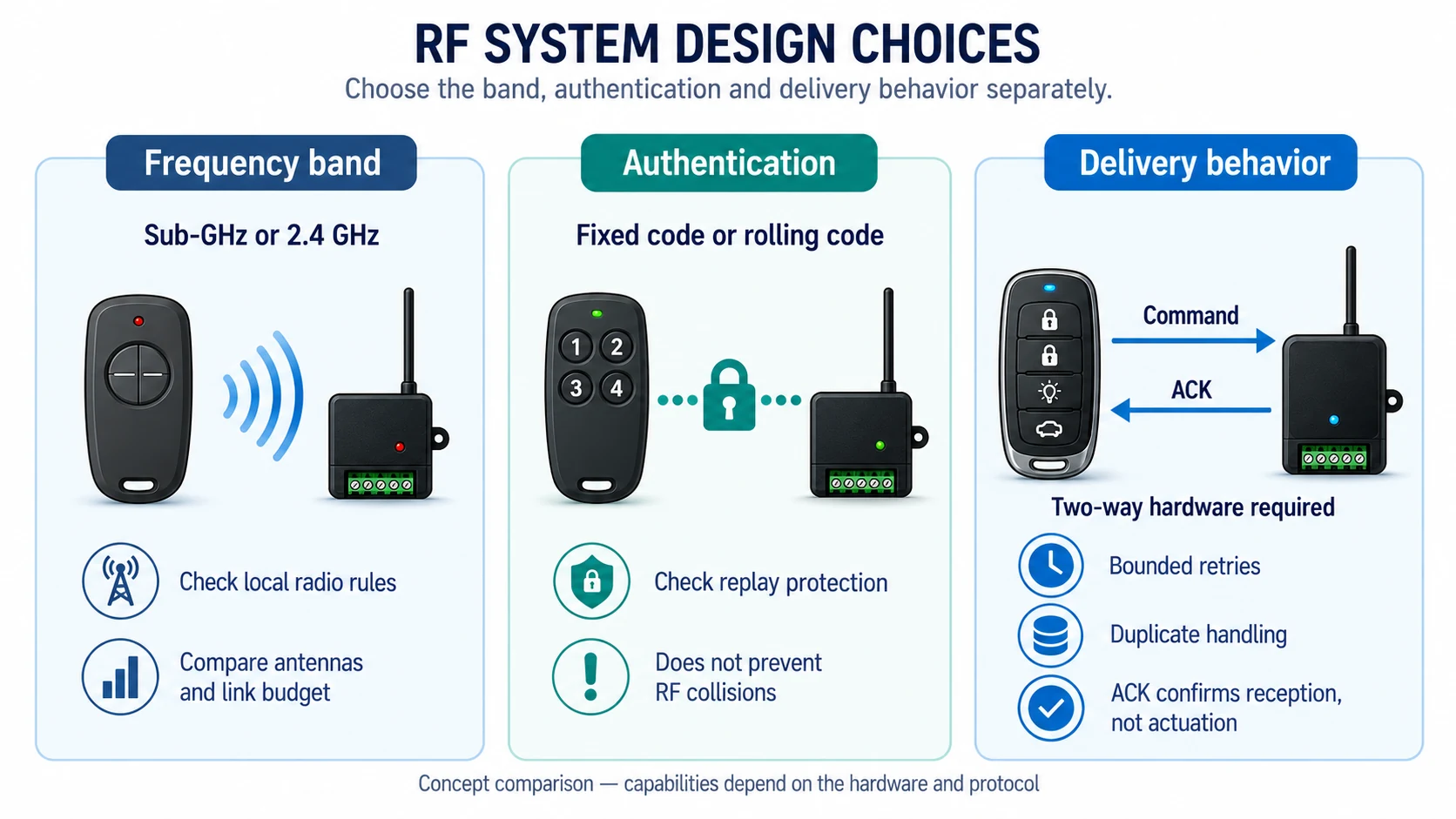
Nordic’s Enhanced ShockBurst guide documents acknowledgment, bounded retries and duplicate packet suppression on compatible two-way hardware. Those features come from the radio and protocol, not simply from operating at 2.4 GHz.
Security is a separate requirement again. A received ACK should not be treated as authentication or as physical-state feedback unless the specified system actually provides those properties.
Test Overlap before Choosing a Remedy
Use the intended receivers and registered remotes. First record each remote’s success alone, then repeat with overlapping presses and varied timing at the same operating locations.
Vary the relative received powers as well as timing: one remote nearby and one at the required far point can expose a different failure from two equally close remotes.
For a two-way system, log missing data, missing ACKs, retries, duplicate suppression and time to accepted command. For a one-way system, observe the controller output directly; transmitter LEDs cannot report reception.
Choose the remedy from that record. Separate channels address overlap only with suitable receivers; time coordination needs synchronization; retransmission needs a repeat policy and duplicate handling.
For sourcing, ask whether the handheld contains a receiver, what success an ACK reports, how long retries may continue and how the controller handles repeated commands. Test those answers before treating “anti-collision” as a product specification.

About the Author
Eric Huang
RF Remote Controls & Controllers Specialist
I work with trade buyers on custom RF remote and controller projects, automotive remote requests and aftermarket gate and garage remote sourcing. These guides help you define product requirements and plan sample checks before ordering.
Share your application or original system, target market and question to discuss the next steps.
Keep reading
Related articles
Different Codes, Same Channel: Why RF Remotes Can Collide
Separate remote identity from radio access, then check how overlapping frames, airtime, repeat timing and two-way protocols affect command delivery.
Read next RF EngineeringRF Transmitter Modules: Check Output and Repeatability
Compare carrier accuracy, matching, unwanted emissions and sample variation under the conditions the finished remote must meet.
Read next OEM/ODMOEM or ODM for RF Remotes: Define the Scope
Compare who designs, who owns the results, how changes are approved and what evidence is delivered before choosing an OEM or ODM arrangement.
Read nextDiscuss Your Project or Replacement
Share your application or original system and your question to discuss the next step.
RF questions by email
Ask Eric About Your Remote or Receiver
Describe your remote or receiver, the issue and what you have already tried. Add model details and your country if available.
Opens a draft in your email app. Review it, attach any photos and send your message.