A practical RF troubleshooting guide for garage door remotes that lose range after LED bulb upgrades, with a 60-second field test and simple fixes for installers.
Reading mapArticle sections7 sections
Sometimes the garage door remote is not the weak part. The real problem is the light bulb sitting beside the receiver.
Modern LED bulbs include switching electronics. When that electronics is poorly filtered, it can create RF noise close to the opener antenna.
For an installer, this looks like a bad remote. For a distributor, it becomes a support ticket that could have been solved in one minute.
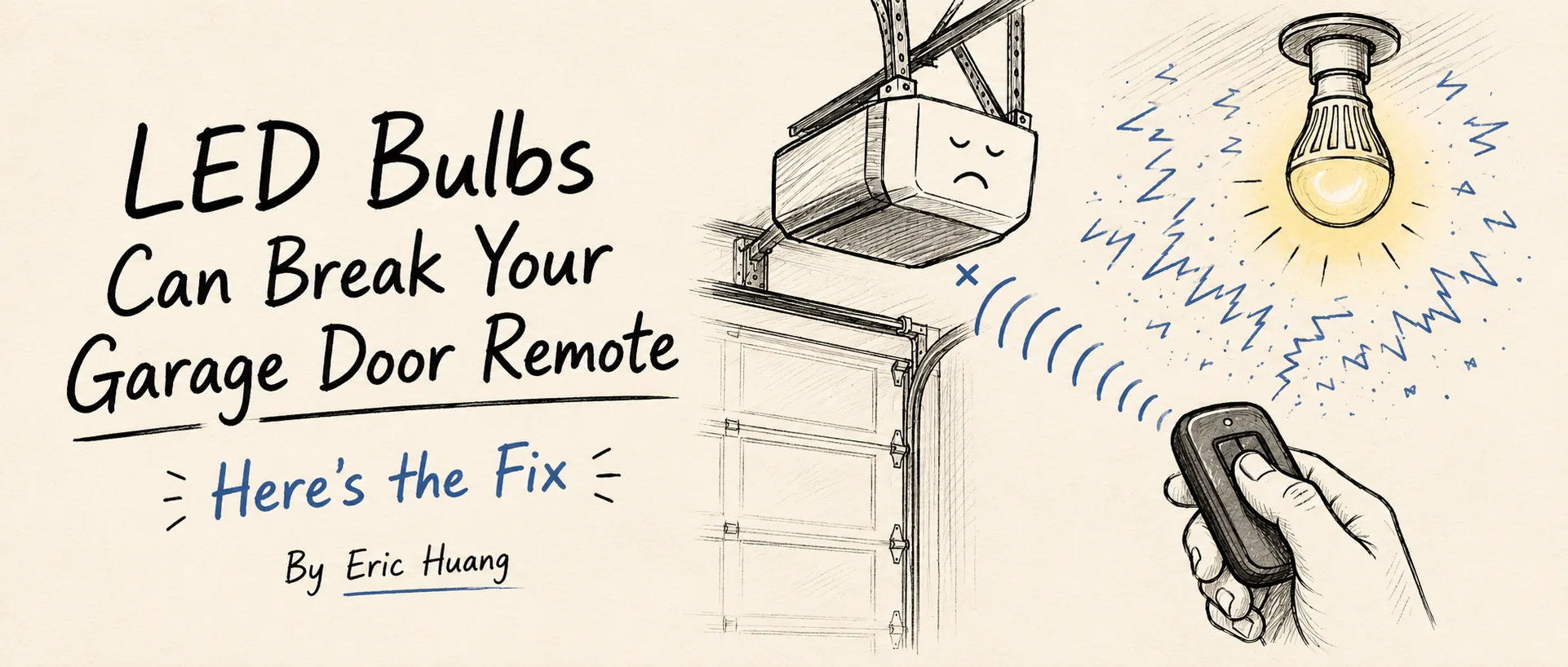
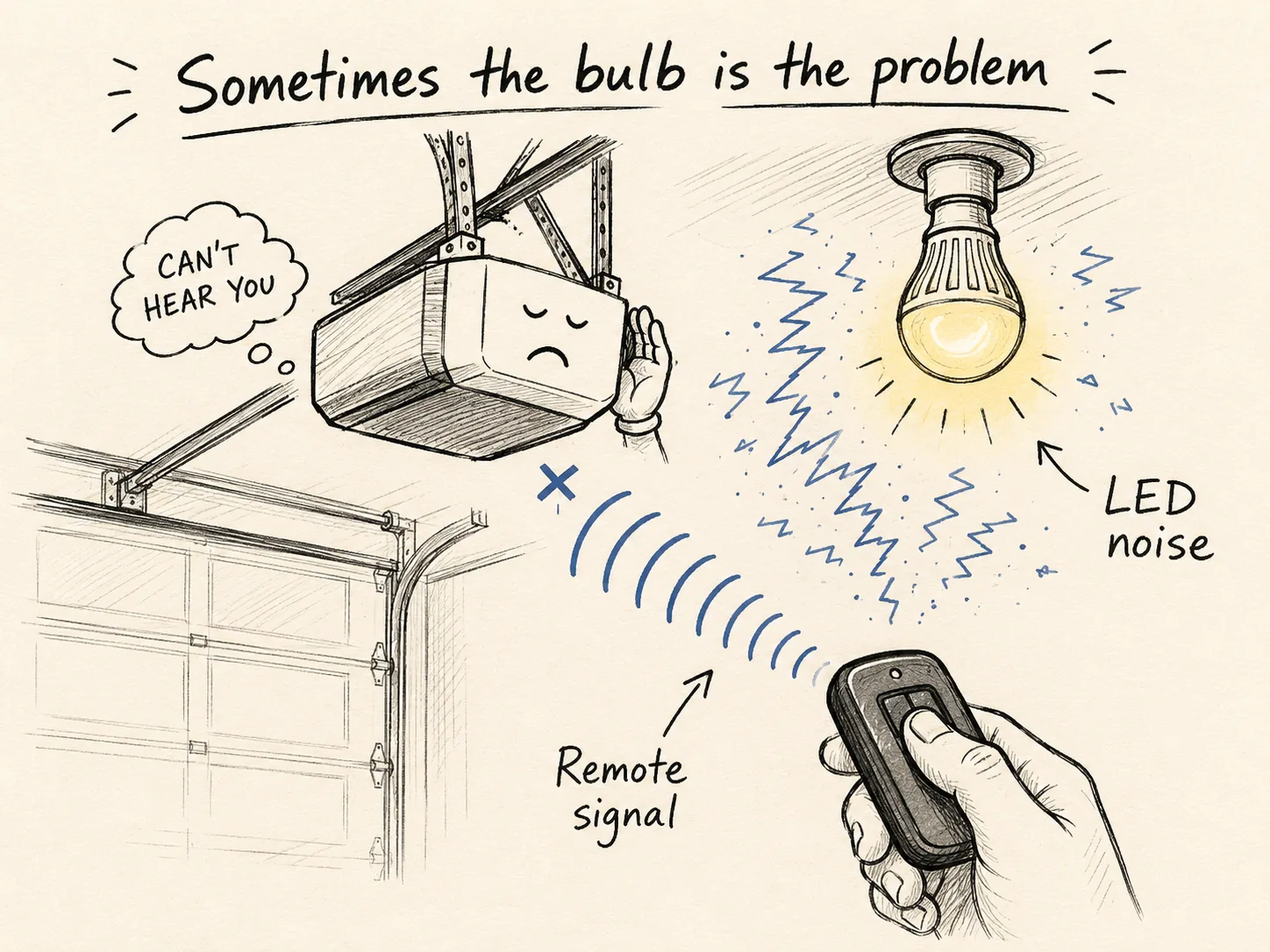
Why an LED Bulb Can Block a Remote Signal
Most garage door remotes transmit a short, low-power RF signal. The receiver inside the opener must hear that signal through a noisy environment: metal doors, vehicles, walls, motors, and nearby electronics.
An LED bulb adds another possible noise source. If the bulb driver leaks interference near the receiver front end, the opener may stop hearing the remote clearly.
Run This 60-Second Test Before Replacing the Remote
Do not start by deleting memory, changing receivers, or blaming rolling code. First isolate the simplest variable.
- Turn the garage opener light off, or remove the LED bulb if the light stays on automatically.
- Stand at the normal failure distance.
- Press the remote again.
- If range comes back immediately, treat the bulb as an interference source.
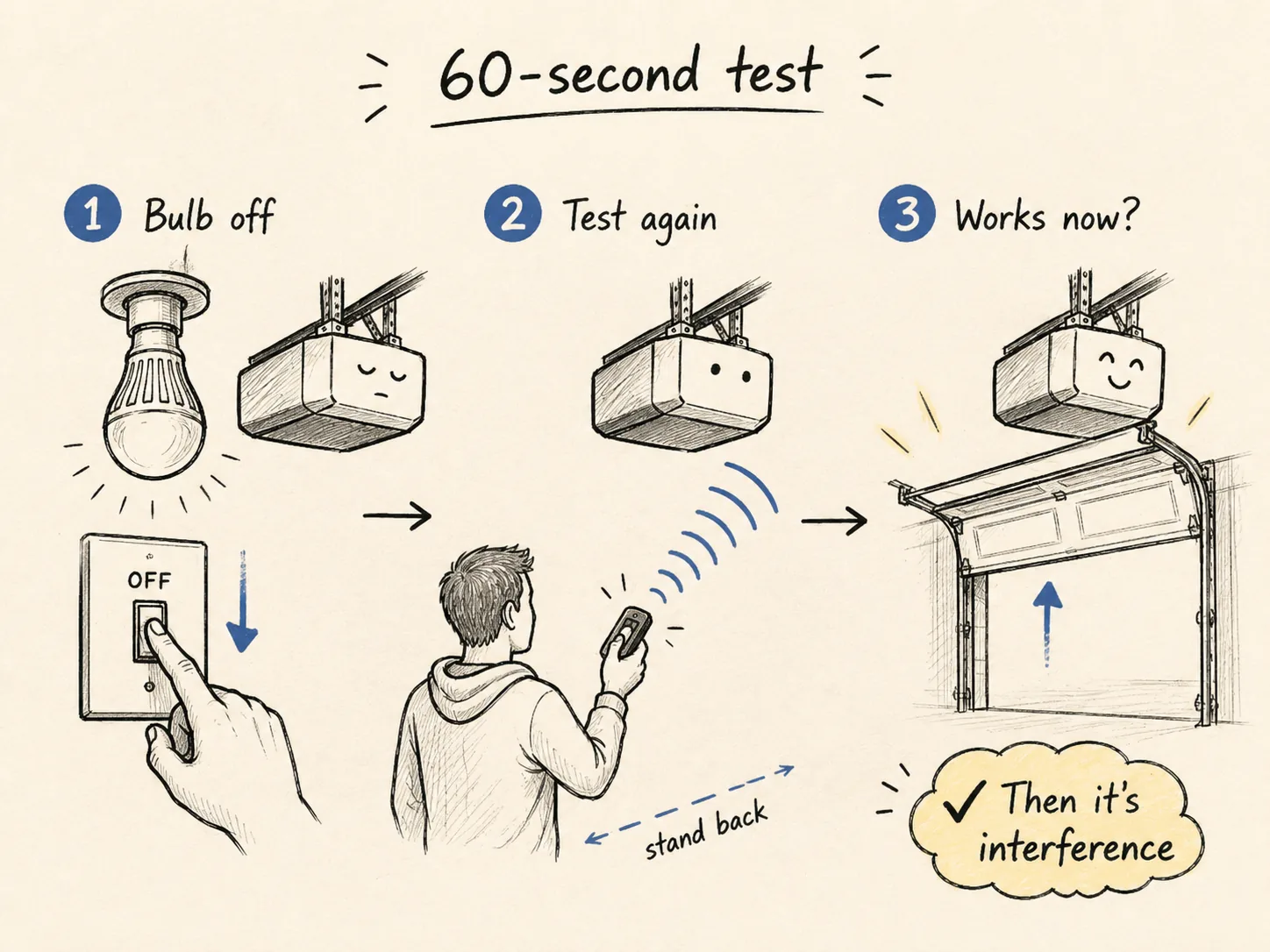
This test is useful because it avoids unnecessary pairing work. If the opener responds after the bulb is removed, the remote was probably not the root cause.
How to Tell Interference Apart From Pairing Failure
LED interference and pairing failure can look similar to the customer. For technicians, the field signs are different.
- Works only when standing close to the opener: check local RF noise or antenna shielding first by turning off nearby LED bulbs and retesting range.
- Receiver LED blinks but the relay does not trigger: check wrong channel mapping or incomplete learning before blaming range.
- Range returns after the bulb is removed: replace or move the LED bulb before changing remotes.
- Failure happens with every bulb and every distance: continue with battery, receiver mode, memory, frequency, and protocol checks.
Four Quiet Fixes That Usually Work
Once the bulb is confirmed as the source, keep the fix simple. The goal is to reduce noise near the receiver, not overcomplicate the installation.
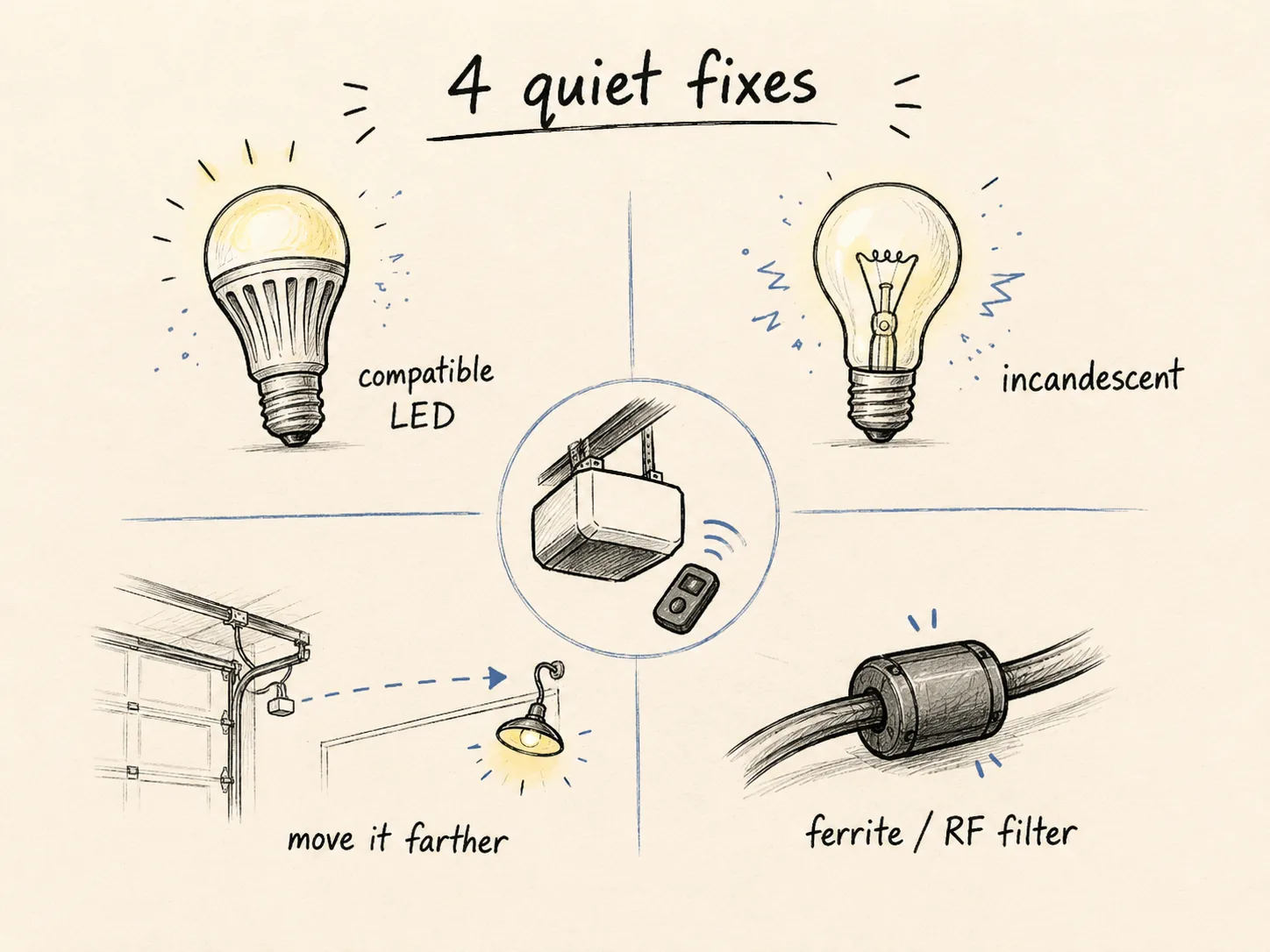
- Use a garage-door-opener-compatible LED bulb with better filtering.
- Temporarily test with an incandescent bulb if local rules and fixture ratings allow it.
- Move the lamp farther from the opener receiver and antenna.
- Add ferrite or filtering only when the installation requires the LED fixture to stay nearby.
What Distributors Should Add to Installer SOPs
For wholesale and installer networks, this should become part of the basic troubleshooting script.
- Ask whether the customer recently changed garage lighting.
- Include an LED bulb off test before remote replacement.
- Record the bulb brand or fixture type when range returns after removal.
- Keep one known-good test remote and one known-quiet bulb in the service kit.
When It Is Not the Bulb
If the 60-second test changes nothing, continue with normal RF diagnosis.
Check the remote battery under load, receiver antenna position, opener memory, frequency family, and protocol compatibility. Do not assume every range issue is LED noise.
Still, the bulb test belongs near the top of the workflow because it is fast, reversible, and easy to explain to customers.
Conclusion
A garage remote does not need a broken button to fail. Sometimes the receiver is simply surrounded by noise.
Before replacing parts, turn off the LED bulb and test again from the normal failure distance. If the door works, you have found the cheapest fix on the job.
The fastest RF fix is often not a new remote. It is removing the noise source that stopped the receiver from hearing the remote.

About the Author
Eric Huang
RF Remote Controls & Controllers Specialist
Hi, I'm Eric Huang, with 10+ years of experience in RF remote controls and controllers. I combine technical expertise with international trade knowledge to provide businesses with reliable, high-quality solutions. My goal is to ensure every client finds a trustworthy product.
Feel free to share your thoughts or ask questions. Let's connect!
Keep reading
Related articles
Same Batch of 433MHz Remotes: One Opens Instantly, One Plays Dead
When two identical 433MHz remotes behave differently on site, the fastest diagnosis starts with battery voltage under load, antenna placement, and electromagnetic interference.
Read next RF EngineeringRF Remote Range: 10 Meters, 30 Meters, or 100 Meters?
RF remote range depends on transmitter power, modulation, antenna design, receiver sensitivity, building materials, and same-frequency interference, so open-field range and indoor range can be very different.
Read next Rolling CodeIs Your Garage Door Actually Secure? A Clear-Eyed Guide to Remote Control Cloning
Garage door remote security depends mainly on whether the system uses fixed code or rolling code. Fixed code can be copied easily; properly implemented rolling code defeats normal replay attacks.
Read nextNeed help now?
Send us your compatibility question and we'll respond directly.
Comments
Leave a comment or RF question
Share your unstable range, batch consistency, matching, filtering, case effect, or export production question. Eric will review the details and reply directly.
Comments are handled by email for now, so you can review the message before sending.