Smart switch protocol choice affects setup, reliability, scale, offline control, ecosystem compatibility, and long-term upgrade flexibility.
Reading mapArticle sections10 sections
Smart switches are one of the most practical entry points into home automation. They fit into existing wiring, work with voice assistants, and usually do not require replacing the rest of the home system.
But behind the simple idea of a switch you can control from your phone sits a more important question: which wireless protocol is it using, and does that choice matter?
It does. Protocol choice affects setup difficulty, device count, reliability, offline behavior, ecosystem compatibility, and future upgrade flexibility.
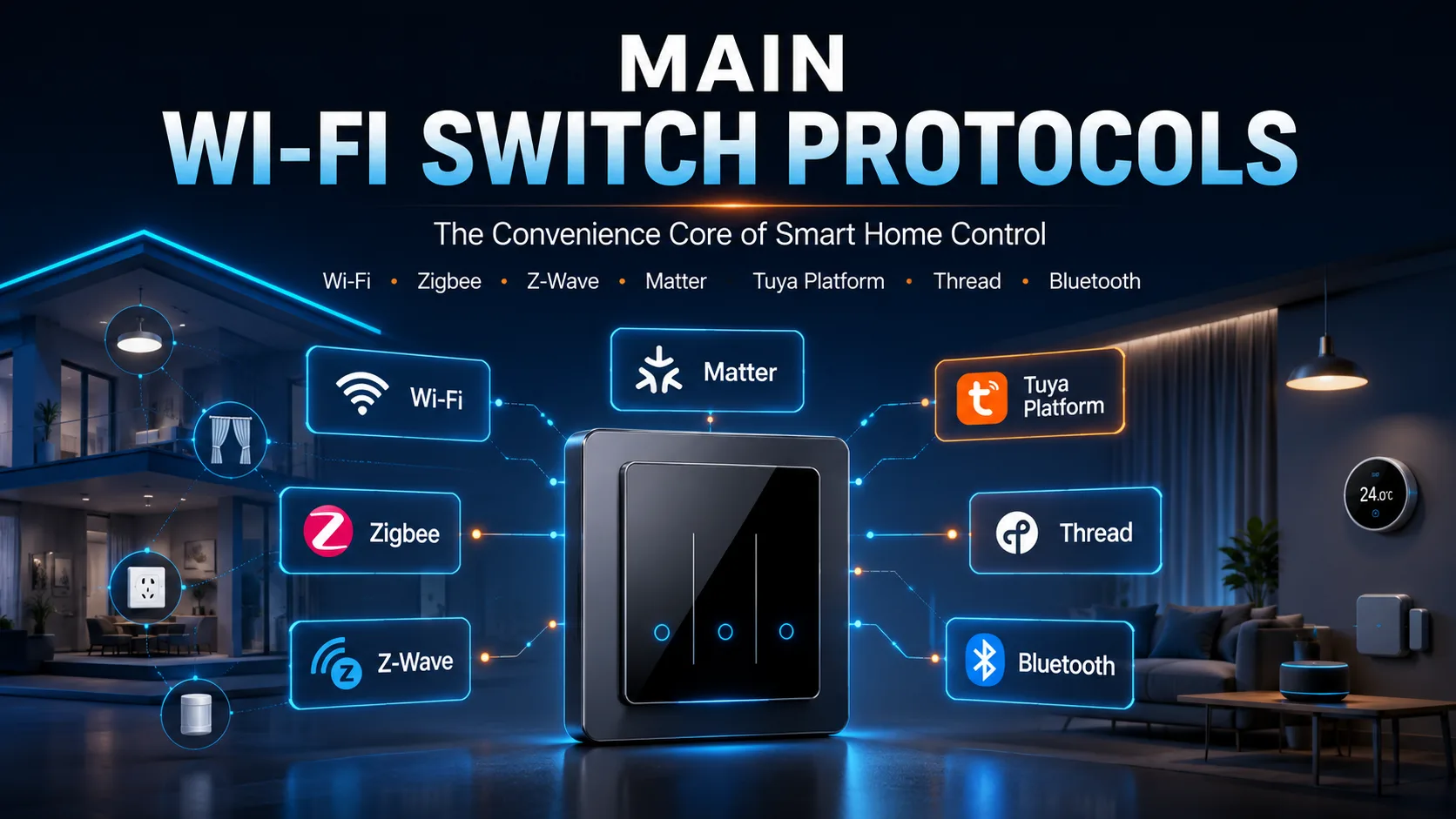
Wi-Fi: The Path of Least Resistance
Wi-Fi is what most people picture when they think of a smart switch. The device connects directly to the home router, no hub is required, and app setup is usually quick.
That simplicity is the reason Wi-Fi switches sell so well. Every home already has Wi-Fi, so there is no extra gateway to explain and no mesh network to plan.
The weakness appears as device count grows. Wi-Fi was built for high-bandwidth traffic such as video, phones, laptops, and data transfer. A switch only needs tiny control packets, but it still occupies router management resources.
For a small home with a few smart devices, Wi-Fi is often the most convenient answer. For a large automated property with dozens of endpoints, reliability depends heavily on router quality, network design, and local interference.
Zigbee: Built for Scale
Zigbee was designed for small data packets, low power consumption, and large numbers of devices. That makes it a natural fit for lighting, sensors, switches, and smart home control.
Its mesh networking is the key advantage. Devices can relay messages for each other, so the network can become stronger as more powered nodes are added in the right places.
Zigbee is strong when the installation needs scale and stable local control. The tradeoff is that it normally requires a hub, which adds one more device to configure and support.
Z-Wave: Reliable, but Regional
Z-Wave operates in sub-GHz bands rather than the crowded 2.4GHz Wi-Fi space. That can make it more predictable in RF-congested homes.
Like Zigbee, it supports mesh networking and has a mature history in security and home automation. Its interoperability certification has also helped devices from different brands work together more consistently.
The tradeoff is ecosystem availability. Z-Wave is strong in markets such as North America and parts of Europe, but device selection and regional frequency support can be more limited elsewhere.
Matter: The Attempt to Reduce Ecosystem Lock-In
Matter is not just another radio. It is an application layer designed to make smart home devices work across major ecosystems such as Apple, Google, Amazon, and Samsung.
Matter can run over Wi-Fi, Thread, and Ethernet. In practical buyer terms, the value is compatibility: one device has a better chance of fitting into multiple platforms without forcing the customer into one brand ecosystem.
The direction is strong, but implementation quality still varies by device category, firmware maturity, and platform support. Matter is promising, but it does not remove the need to test the actual device in the actual ecosystem.
Tuya: A Platform, Not a Protocol
Tuya is often mentioned next to protocols, but it is more accurate to describe it as a cloud platform and development ecosystem.
Manufacturers use Tuya to bring connected products to market quickly. Tuya can support Wi-Fi, Zigbee, Bluetooth, and other underlying communication paths while providing app control, automation, cloud services, and voice assistant integration.
The advantage is speed and ecosystem breadth. The tradeoff is cloud dependence and platform dependence. Local control capability varies by device, gateway, and configuration.
Thread: The Infrastructure Layer Worth Knowing
Thread is a low-power mesh networking protocol built on IP-based networking ideas. It is the transport layer Matter often uses when the product is not using Wi-Fi.
Its value is efficient mesh communication, low power operation, and future-friendly integration with modern smart home infrastructure.
Most users do not choose Thread directly in the same way they choose Wi-Fi. They usually encounter it through Matter devices and border routers such as smart speakers or hubs that bridge the Thread network to the home network.
Bluetooth: Short Range, Specific Uses
Bluetooth has a narrower role in whole-home automation. Its reliable range is usually room-scale or nearby-room scale, depending on building structure and product design.
The advantage is direct device communication without depending on the home Wi-Fi network or a cloud account. That is useful for setup, commissioning, proximity functions, and simple local control.
The limitation is coverage. Bluetooth is not normally the right foundation for a large smart home unless it is part of a broader gateway or mesh architecture.
How to Actually Choose
The right protocol depends on device count, reliability requirements, and ecosystem direction.
- For a few switches in a small home, Wi-Fi is usually the simplest and lowest-friction choice.
- For a larger installation with many switches and sensors, Zigbee or Thread-based infrastructure often scales better.
- For RF-congested homes in Z-Wave-supported markets, Z-Wave can be a reliable option.
- For cross-platform compatibility, Matter is the lowest-regret direction when the device implementation is mature.
- For fast OEM development and broad app support, Tuya can reduce time to market, but cloud dependence must be understood.
- For local setup, proximity features, or simple room-scale control, Bluetooth can be practical but should not be treated as a whole-home backbone.
Buyer Checklist
- How many devices will be connected now, and how many in two years?
- Does the switch need to work when the internet is down?
- Is a hub acceptable for the target user, or must setup be hub-free?
- Which ecosystem matters most: Apple Home, Google Home, Alexa, SmartThings, Tuya, or private cloud?
- Is the product for a small apartment, a villa, a rental project, or a commercial installation?
- Does the target market require specific certification, labeling, language, or cybersecurity documentation?
The Bottom Line
There is no universally correct protocol. Wi-Fi is genuinely fine for a small home with a stable router. Zigbee is genuinely better for many large installations that need scale. Z-Wave is strong where its ecosystem is mature. Matter is the direction to watch if long-term compatibility matters.
The important thing is not memorizing protocol names. It is matching the protocol to the actual use case: device count, offline behavior, installation scale, ecosystem, and support expectations.
A smart switch protocol is not just a technical choice. It decides how much support the product will need after it is installed.

About the Author
Eric Huang
RF Remote Controls & Controllers Specialist
Hi, I'm Eric Huang, with 10+ years of experience in RF remote controls and controllers. I combine technical expertise with international trade knowledge to provide businesses with reliable, high-quality solutions. My goal is to ensure every client finds a trustworthy product.
Feel free to share your thoughts or ask questions. Let's connect!
Keep reading
Related articles
Why Serious Smart Switches Are Moving to RF + Wi-Fi Dual-Mode
RF + Wi-Fi dual-mode smart switches solve the two problems Wi-Fi-only products struggle with most: local control when the network fails and cloud control when the user needs automation.
Read next Чек-лист покупателяExporting Wi-Fi Switches to the EU: What Does CE Actually Require?
For Wi-Fi switches and smart plugs, CE is not a single certificate. It is a compliance loop covering RED, RoHS, technical documentation, labeling, instructions, DoC, economic operator details, and market obligations.
Read next Чек-лист покупателя10 Real-World Application Scenarios: How RF Remotes and Controllers Actually Deliver Wireless Control
RF remotes and controllers work best when the scenario, control logic, load type, installation environment, interference risk, and after-sales management are matched before the product is selected.
Read nextНужна помощь сейчас?
Отправьте нам свой вопрос по совместимости, и мы ответим напрямую.
Comments
Leave a comment or RF question
Share your unstable range, batch consistency, matching, filtering, case effect, or export production question. Eric will review the details and reply directly.
Comments are handled by email for now, so you can review the message before sending.