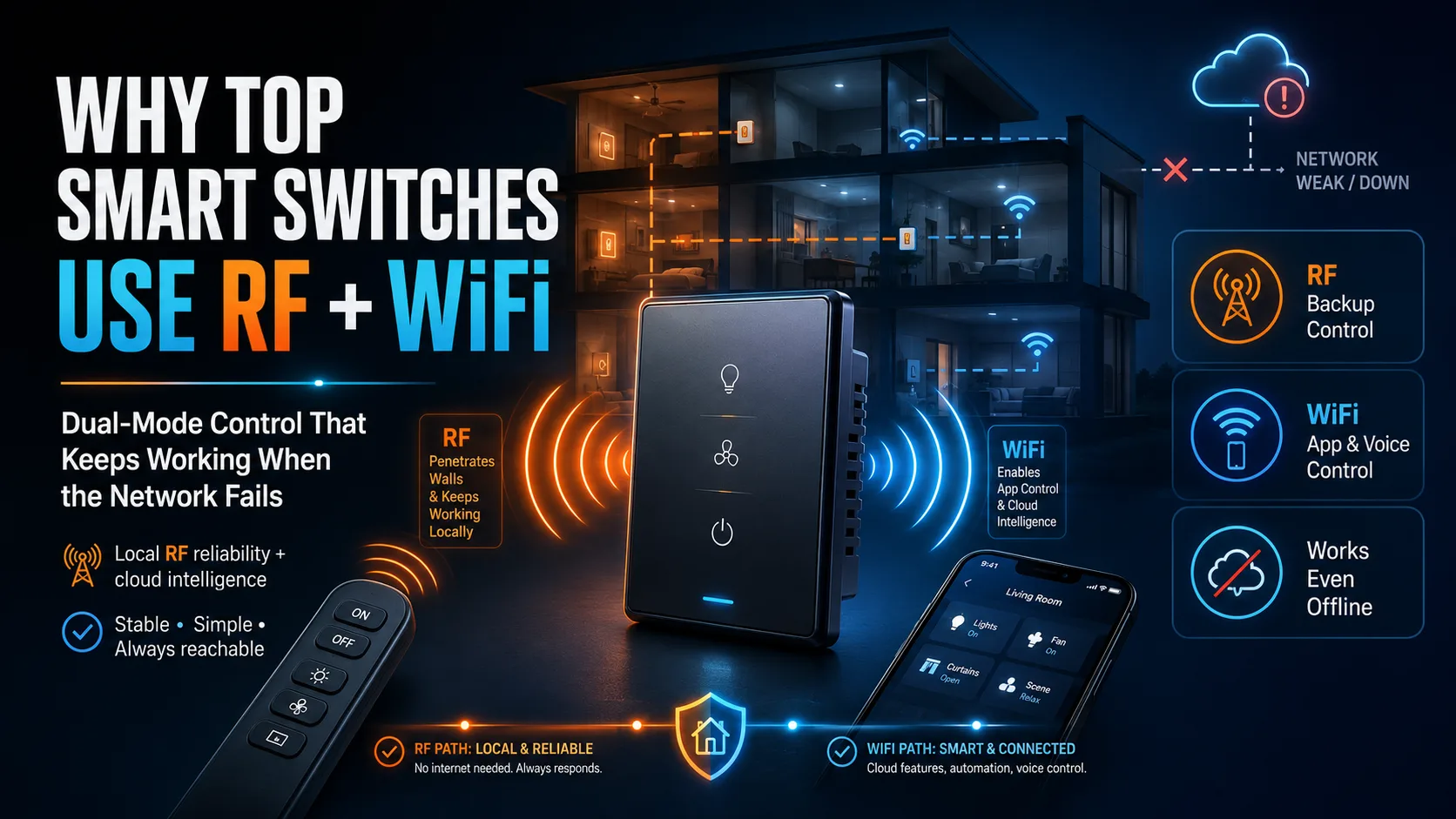
RF + Wi-Fi dual-mode smart switches solve the two problems Wi-Fi-only products struggle with most: local control when the network fails and cloud control when the user needs automation.
Reading mapArticle sections8 sections
The smart home market has spent years pushing everything toward Wi-Fi. That approach made app control easy, but it also created a reliability problem that buyers can no longer ignore.
Once a home or apartment project has dozens of connected devices on the same router, switches that were responsive on day one can start lagging, freezing, or dropping offline.
The bigger problem is what happens when the network itself fails. A router reboot, weak signal, or cloud outage can turn expensive smart lighting into something less convenient than a standard wall switch.
For system integrators, property developers, and OEM brand owners, the requirement is becoming clearer: a smart switch must work locally even when the cloud is unavailable.
The Problem in a Wi-Fi-First World
A Wi-Fi-only smart switch depends on the local network, router stability, cloud service, account state, and app path all working at the same time.
That is acceptable for many convenience features. It is much less acceptable for basic control that users expect to work instantly, especially lights, curtains, gates, and access-related loads.
A 75-year-old user should not need to unlock a phone, wait for an app, and hope the router is stable just to turn on a light. A household with children should not lose basic switch behavior because the internet is down.
That is the commercial reason RF + Wi-Fi dual-mode architecture keeps showing up in procurement discussions. It is not about adding a feature for the spec sheet. It is about preserving the basic behavior of a switch.
Why 433MHz Still Matters Through Walls
This comes down to physics, not nostalgia.
Wi-Fi commonly operates at 2.4GHz, with a wavelength of roughly 12.5cm. At that frequency, reinforced concrete, floor slabs, water, furniture, and human bodies can all reduce usable signal quality.
433MHz RF has a wavelength around 69cm. The longer wavelength gives it better diffraction and penetration behavior in many residential and light commercial environments.
In a real building, that difference matters. A router on the ground floor may struggle to keep a stable Wi-Fi path to a corner room upstairs, while a simple 433MHz handheld remote can still trigger a local receiver with almost no perceptible delay.
That does not mean RF replaces Wi-Fi. It means RF should be treated as the guaranteed local-control layer, while Wi-Fi handles app control, scenes, automation, voice assistant integration, and remote access.
The Hard Part Is Radio Coexistence
A lot of people hear dual-mode and assume the design is simple: put a Wi-Fi module and an RF module in the same enclosure.
In production engineering, that is where the real work begins.
Wi-Fi modules generate strong electromagnetic emissions during data bursts. RF receiver circuits, especially sensitive superheterodyne designs, are much more vulnerable to noise.
If the two sections are placed too casually on the same PCB, the failure mode is easy to recognize: the physical remote becomes unreliable when the app is communicating, or Wi-Fi stability drops when local RF activity increases.
This is not a problem that can be fixed by marketing language after the product is built. It has to be solved in schematic design, layout, power architecture, and firmware scheduling.
Power Isolation and Timing Are the Real Design Work
Two approaches matter most in production: power isolation and time-domain coordination.
Power isolation means the Wi-Fi section and RF section should not share noisy supply behavior. Separate filtering, careful grounding, and LDO regulators with strong PSRR help prevent one radio path from contaminating the other.
Layout matters just as much. RF traces, antenna areas, ground returns, module placement, and switching power paths all need to be planned before the first prototype is built.
Time-domain coordination is handled in firmware. When the MCU detects a local RF command, the product can prioritize that short local-control window, process the command quickly, and then resume normal Wi-Fi activity.
The timing window needs to be short enough that Wi-Fi does not drop, but wide enough that the RF packet is reliably received and decoded.
Manufacturing Is Where the Design Holds or Falls Apart
A schematic is only the beginning. Manufacturing decides whether the design survives batch production.
During component supply pressure, some factories substitute lower-grade oscillators to protect margins. For RF products, that is a dangerous place to save money.
A 433.92MHz product with poor frequency stability may look fine in the factory room but become unreliable in cold or hot field conditions. The customer sees short range, delayed response, or complete failure to trigger.
Industrial-grade crystal selection, controlled oscillator tolerance, and temperature validation are not decorative quality points. They are what keep the RF path alive outside the lab.
RF calibration after SMT is another serious step. Spectrum verification checks center frequency and emissions. Antenna matching adjusts the actual board and enclosure combination so the finished product radiates efficiently.
For dual-mode products, stress testing should also include heavy Wi-Fi traffic while RF commands are being triggered repeatedly. That is how you find the failures that only appear when both radios are working hard.
Where Dual-Mode Actually Earns Its Cost
Dual-mode is not necessary for every product. It earns its cost when local reliability and cloud convenience both matter.
Smart lighting is the obvious case. Wi-Fi supports app control, voice assistants, schedules, and scenes. RF supports a stick-anywhere remote for bedside, elderly-user, or backup local control.
Motorized curtains and roller shutters are another strong fit. The motor controller is often placed near metal structures or inside a housing that makes Wi-Fi unreliable. RF gives the installer another dependable local path.
Security and alarm systems also show the logic clearly. Low-power RF sensors can run for long periods on batteries and report to a local gateway. The gateway then uses Wi-Fi for app alerts and cloud connectivity.
- Lighting: RF for local switching, Wi-Fi for app, voice, scenes, and scheduling.
- Curtains and shutters: RF for wall penetration and local motor control, Wi-Fi for automation.
- Security sensors: low-power RF for endpoints, Wi-Fi for gateway-to-cloud communication.
- Access control: RF for local trigger reliability, Wi-Fi for logs, remote management, and user permissions.
ODM Requirements Buyers Should Clarify Early
For OEM and ODM projects, dual-mode design touches more than the PCB.
Protocol compatibility needs to be defined early: Tuya, eWeLink, private cloud, local gateway, or a custom app stack all change firmware planning and certification scope.
Industrial design also matters. Glass panels, plastic housings, metal frames, and button structures all affect antenna behavior. The enclosure cannot be treated as a separate cosmetic decision.
Regional certification should be mapped before tooling. FCC, CE-related requirements, SRRC, and destination-market rules can affect frequency choice, transmit power, cybersecurity obligations, labeling, and documentation.
- Target market and required certifications
- Wi-Fi platform or cloud ecosystem
- RF frequency, coding system, and receiver architecture
- Enclosure material and antenna location
- Fallback behavior when Wi-Fi, cloud, or app control is unavailable
- Expected installation environment and load type
The Underlying Logic
Technology keeps moving. What users want has not changed much: stable, simple, reliable control.
RF and Wi-Fi together are not a step backward. They are a pragmatic response to the failure modes of a purely cloud-dependent architecture.
A switch that works when the internet is down is not a luxury feature. For most users, it is the baseline expectation of a switch.
The best dual-mode switch does not make users think about RF or Wi-Fi. It simply keeps working, locally and remotely, in the conditions where real homes actually operate.
If a product line is generating complaints about Wi-Fi dropouts, the starting point is not only protocol choice. It is the full scenario: operating environment, target market, certification requirements, installation method, and expected volume.

About the Author
Eric Huang
RF Remote Controls & Controllers Specialist
Hi, I'm Eric Huang, with 10+ years of experience in RF remote controls and controllers. I combine technical expertise with international trade knowledge to provide businesses with reliable, high-quality solutions. My goal is to ensure every client finds a trustworthy product.
Feel free to share your thoughts or ask questions. Let's connect!
Keep reading
Related articles
Exporting Wi-Fi Switches to the EU: What Does CE Actually Require?
For Wi-Fi switches and smart plugs, CE is not a single certificate. It is a compliance loop covering RED, RoHS, technical documentation, labeling, instructions, DoC, economic operator details, and market obligations.
Read next Чек-лист покупателя10 Real-World Application Scenarios: How RF Remotes and Controllers Actually Deliver Wireless Control
RF remotes and controllers work best when the scenario, control logic, load type, installation environment, interference risk, and after-sales management are matched before the product is selected.
Read next RF EngineeringYour Remote Control Has a Hearing Problem: How Receiver Sensitivity Decides RF Range
Receiver sensitivity is the spec that tells you how weak a signal the receiver can still decode, and it often matters more for usable RF range than louder transmit power.
Read nextНужна помощь сейчас?
Отправьте нам свой вопрос по совместимости, и мы ответим напрямую.
Comments
Leave a comment or RF question
Share your unstable range, batch consistency, matching, filtering, case effect, or export production question. Eric will review the details and reply directly.
Comments are handled by email for now, so you can review the message before sending.