A CR2032 can keep an RF remote alive for years only when the whole circuit treats standby current, RF pulses, GPIO leakage, LEDs, and wake-up timing as one fragile energy budget.
Reading mapArticle sections12 sections
I was recently going through some materials on low-power design for RF remotes, starting with what seemed like a simple question.
A small garage door remote runs on one CR2032 coin cell. Why do some customers use it for two or three years without a problem, while others start having issues after only six months?
At first, I thought the answer was probably battery quality. Buy Panasonic, Energizer, or Maxell and it lasts longer. Buy a no-name brand and the capacity is inflated. That sounds reasonable.
But the more I looked at it, the more I realized the answer is not that simple. What often determines the life of an RF remote is not the battery alone. It is whether the engineer treated that little cell as an extremely fragile energy account.
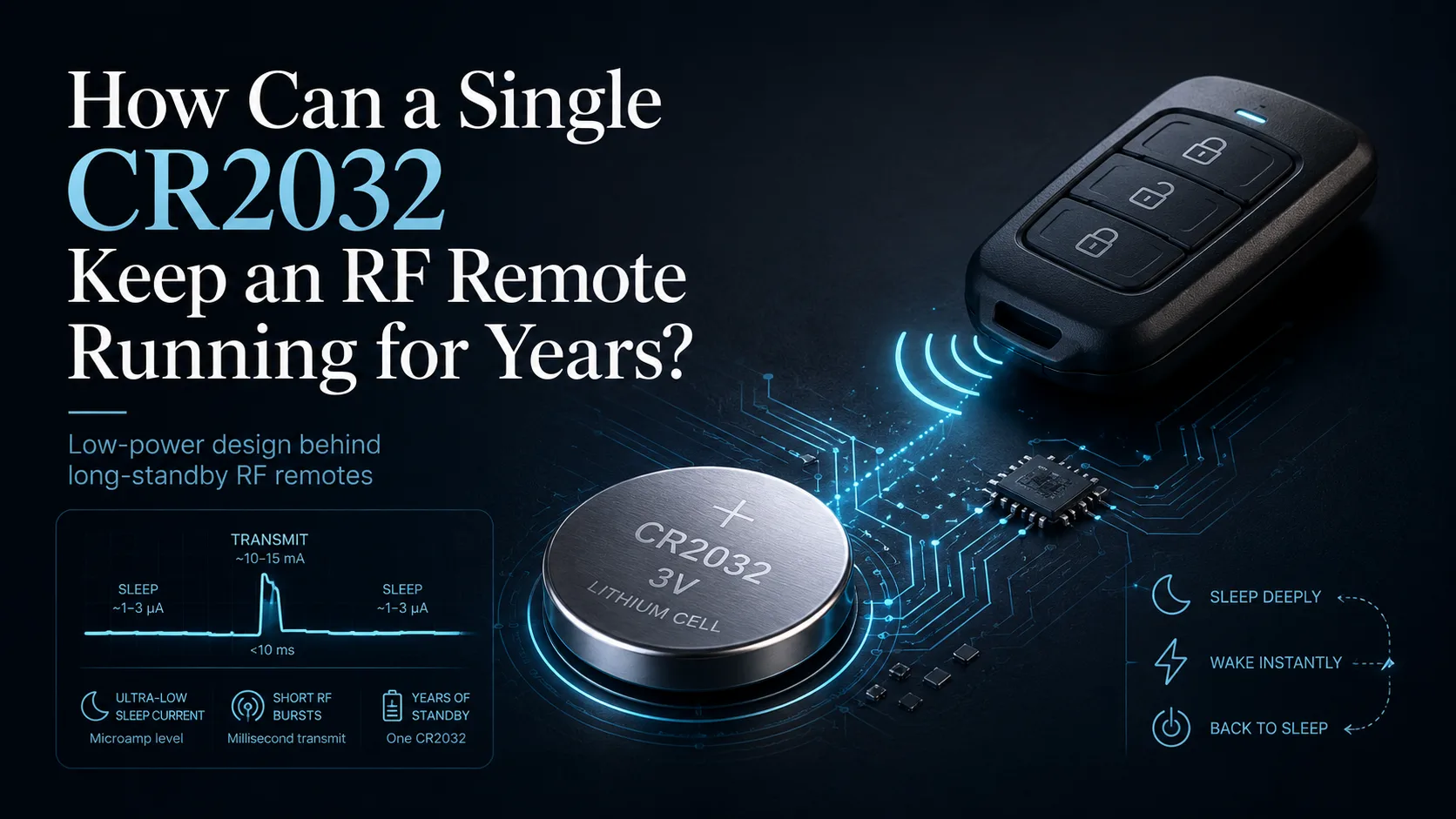
The CR2032 Is Not a Miniature Power Bank
A CR2032 is more like a wealthy but frugal old man. Let him spend a little each day and he can last a long time. Ask him to hand over a large sum at once and he may manage, but he will strain. Keep pushing him through large swings every day and he will stop cooperating.
That analogy is rough, but it is close to how a CR2032 behaves inside an RF remote.
Panasonic lists a nominal voltage of 3V, rated capacity of 225mAh, continuous discharge current of 0.2mA, and remote keyless entry, card remotes, and smart transmitter tags as typical CR2032 applications. So yes, the CR2032 is genuinely suitable for remotes.
But notice the 0.2mA number. That is 200uA. Many people see 225mAh and think it sounds like a decent amount of energy. For a remote expected to last three to five years, the average current budget is brutally tight.
- 225mAh over 3 years, roughly 26,280 hours, is about 8.56uA average.
- 225mAh over 5 years is about 5.14uA average.
- That means the entire 3-year average current budget is only around 8uA.
Once you see those numbers, low-power design cannot be hand-waved away with "we used a low-power chip".
- One GPIO left in the wrong state can lose a few microamps.
- A debug port left open can lose a few more.
- An LED that stays on a few hundred milliseconds too long takes a real slice of battery life.
- Poor button debounce can create false triggers that quietly drain the battery while the customer sees nothing.
What Customers Ask vs What Engineering Gives You
This reminds me of a question that comes up constantly in customer conversations: "How long will this remote last?"
That question is genuinely hard to answer directly. Saying two years, three years, or five years can sound like a sales pitch. The honest engineering answer is that it depends on average current, transmit duration, press frequency, battery brand, temperature, transmit power, protocol design, and hidden PCB leakage.
Customers want a single clean answer. Engineering gives you a pile of constraints. That is the reality of hardware. Physics does not do marketing.
The Battery Is Not Just a Bucket
Energizer lists a typical CR2032 capacity of 235mAh, tested at a 15 kOhm load, 21 C, down to a 2.0V cutoff. It also lists roughly 1% self-discharge per year and includes a useful pulse test: 2-second pulses, 12 times per day, at a 400 Ohm load, producing a pulse current of about 6.8mA.
That pulse detail matters because a remote does not drain the battery smoothly. Most of the time it is asleep. When the user presses a button, it wakes up, encodes, transmits, and immediately goes back to sleep.
So the current profile of an RF remote is not a smooth line. It is a series of sharp spikes. Idle current might be 1 to 2uA. The moment the radio fires, current can jump to 10 to 20mA or higher.
A Nordic Semiconductor and Energizer white paper makes this point directly: when wireless products activate RF circuitry, current can reach 10 to 80mA, far above the roughly 200uA level associated with rated CR2032 capacity. High peak pulses cause voltage sag and reduce usable capacity.
225mAh is not a bucket you can drain however you like.
Sip it slowly and it lasts a long time. Pull a high pulse through it and the pressure collapses before all the energy is actually gone.
This is why some remotes start dropping range, misbehaving, or failing to respond even when the battery still has charge left. The issue is often not that the battery is empty. The issue is that voltage collapses during transmission and the MCU or RF chip cannot hold on.
This is especially tricky late in product life. Everything works with a new battery. Everything looks fine in the lab. Then months later, internal resistance has climbed, the temperature drops, the user presses the button several times in a row, and the problem finally appears.
The Core Design Philosophy
Sleep like you are dead. Wake up like lightning. The moment you are done, go right back to sleep.
That is the essence of long-standby RF remote design.
- Sleep like you are dead: push standby current down to the microamp level, as close to true shutdown as possible.
- Wake up like lightning: keep wake-up, encoding, and transmission short, minimal, and fast.
- Go back to sleep immediately: shut down RF, clocks, peripherals, and LEDs the moment the job is done.
Chip Selection: Integration Matters
For small RF remotes, a highly integrated low-power RF SoC is usually the right direction. The Silicon Labs Si4010 is a textbook example: single coin-cell transmitter, 1.8 to 3.6V supply, standby current under 10nA, 27 to 960MHz range, and OOK and FSK support, with garage and gate openers, home automation, and remote keyless entry listed as target applications.
The value is not just in one attractive spec. It is in the integration. Fewer external components mean fewer places for current to leak, fewer layout risks, and fewer small mistakes that later become customer complaints.
GPIO Configuration Can Decide the Battery Life
ST low-power GPIO guidance is clear: if a GPIO does not need to be read, configure it as an analog input to eliminate Schmitt trigger power draw. Before entering low-power mode, every pin should be explicitly pulled to VDD or GND. No floating states.
Many low-power designs do not fail because of sophisticated technical mistakes. They fail because of one floating pin. In a product where the entire current budget is only a few microamps, one floating pin is a serious problem.
Button Handling: False Wake-Ups Are a Silent Killer
Polling, where the MCU wakes periodically to check for a button press, can work. But for long-standby products, edge-triggered interrupt wake-up is usually cleaner. The system sleeps as deeply as possible and leaves only one narrow wake-up path open.
Debouncing is non-negotiable. False wake-ups quietly drain the battery. The customer will not know the remote woke itself ten times while sitting in a drawer. They will only notice one day that the battery died too soon.
RF Transmission: Range Is Not Free
Customers love asking about range. That is natural. For a garage remote, range is the most tangible experience metric. But range is not free. Higher transmit power, longer packet duration, and more retransmit attempts all put more pressure on the CR2032.
Microchip RF design material covers transmitter chips such as the MICRF112 for 300 to 450MHz ASK and FSK applications, with +10dBm output, standby current under 1uA, operation down to 1.8V, and key fob transmitters as a design target.
The lesson is not that low power means weak transmission. The lesson is that transmission should appear only when it is actually needed.
LEDs Look Innocent but Spend Real Energy
LEDs are an easy place to lose battery life because they look so harmless. A tiny red light does not feel like a major load, but if it is too bright, on too long, or triggered generously on every keypress, it becomes a real drain on a CR2032.
Keep LED feedback to a short status flash. If 30ms is enough, do not use 300ms. Prefer low duty cycle over high brightness. Never use always-on indication in a coin-cell remote.
It Is a System, Not a Single Fix
So how does a CR2032 achieve a long standby life? The answer is not one magic component. Not a better battery alone, not a different chip alone, not lower transmit power alone, and not one line of firmware that says "enter low-power mode".
It is a system engineering problem.
- Use the right battery for the target product life.
- Choose a low-leakage chip and a suitable RF architecture.
- Configure every GPIO deliberately before sleep.
- Use interrupt-driven button wake-up instead of lazy polling where possible.
- Keep RF transmissions short and protocol frames compact.
- Control retransmit behavior during long presses.
- Use LED feedback sparingly.
- Keep PCB layout free from leakage paths and floating nodes.
- Make firmware sleep the moment the job is done.
- Test low temperature, aged batteries, voltage sag, and rapid repeated keypresses.
The hardest part of low-power design is not producing an impressive lab measurement. It is making sure that one year, two years, or three years later, when the customer presses that button, the remote still responds reliably.
Hardware Longevity Is Trust
Software can be patched. Webpages can be corrected. Copy can be deleted and rewritten. But once a remote ships, it is out there in the customer's hand, on a keychain, in a car, near a warehouse door, in the cold, in the rain, sitting quietly until the next press.
It has no way to explain itself. It only gets one chance. Press the button. The door opens.
That simple experience is supported by a whole discipline of restrained engineering: almost no power consumption at rest, instant wake on button press, task complete, back to sleep.
The more I work with hardware, the more I appreciate this: a product's true quality is often not in how it looks or what the spec sheet claims. It is in whether it keeps working reliably in the moments when the user has completely forgotten it exists.
One CR2032 carries more than energy for a remote. It carries the user's trust in that little thing.
References
- Panasonic CR2032 datasheet: 3V nominal voltage, 225mAh rated capacity, 0.2mA continuous discharge, and remote-control applications.
- Energizer CR2032 datasheet: 235mAh typical capacity, roughly 1% per year self-discharge, and continuous and pulse discharge test data.
- Nordic Semiconductor and Energizer white paper: CR2032 voltage and usable capacity impact under high-pulse wireless loads.
- ST AN4899: GPIO hardware settings and low-power configuration recommendations.
- Silicon Labs Si4010 datasheet: single coin-cell RF transmitter SoC with sub-10nA standby current.
- Microchip RF Basics Design Guide: 300 to 450MHz remote transmitter chips and low-standby-current design references.

About the Author
Eric Huang
RF Remote Controls & Controllers Specialist
Hi, I'm Eric Huang, with 10+ years of experience in RF remote controls and controllers. I combine technical expertise with international trade knowledge to provide businesses with reliable, high-quality solutions. My goal is to ensure every client finds a trustworthy product.
Feel free to share your thoughts or ask questions. Let's connect!
Keep reading
Related articles
Circuits Don't Act: Why I Hate "Good Enough" Transmitter Modules More and More
A transmitter module is not reliable just because it can send a signal. Real quality depends on stability, clean output, tuning margin, and repeatable mass production.
Read next RF EngineeringRF Remote Concurrency and Collision Avoidance: From the Physical Layer to the Protocol Layer
When many RF remotes share the same channel, reliability depends on how the system handles shared spectrum, interference, timing, hidden terminals, acknowledgments, and recovery.
Read next Устранение неисправностейWhy Clone Remotes Show Success But the Door Still Won't Open
Most clone remote failures are not user mistakes. They come from frequency mismatch, incompatible code type, rolling-code security, proprietary protocol logic, or weak RF hardware.
Read nextНужна помощь сейчас?
Отправьте нам свой вопрос по совместимости, и мы ответим напрямую.
Comments
Leave a comment or RF question
Share your unstable range, batch consistency, matching, filtering, case effect, or export production question. Eric will review the details and reply directly.
Comments are handled by email for now, so you can review the message before sending.