For hardware startups, OEM and ODM are not just production labels. They decide who controls the product, the certification path, and the future leverage in the supply chain.
Reading mapArticle sections7 sections
You may think you are choosing a production method, but in hardware you are often choosing a completely different future.
A friend of mine was recently confused by three different factories while working on a smart home project. He needed an RF remote control, but each factory gave him a different suggestion. One offered OEM, another offered ODM, and another said it could do ODM customization.
He asked me, "Do you know about this?" I told him that I knew a little, but his situation was very common. Most people entering hardware think they are choosing a production method. In reality, they are choosing a path for the product and the company behind it.
These two options look close from the outside, but the logic behind them is completely different.
OEM and ODM Are Not the Same Business Path
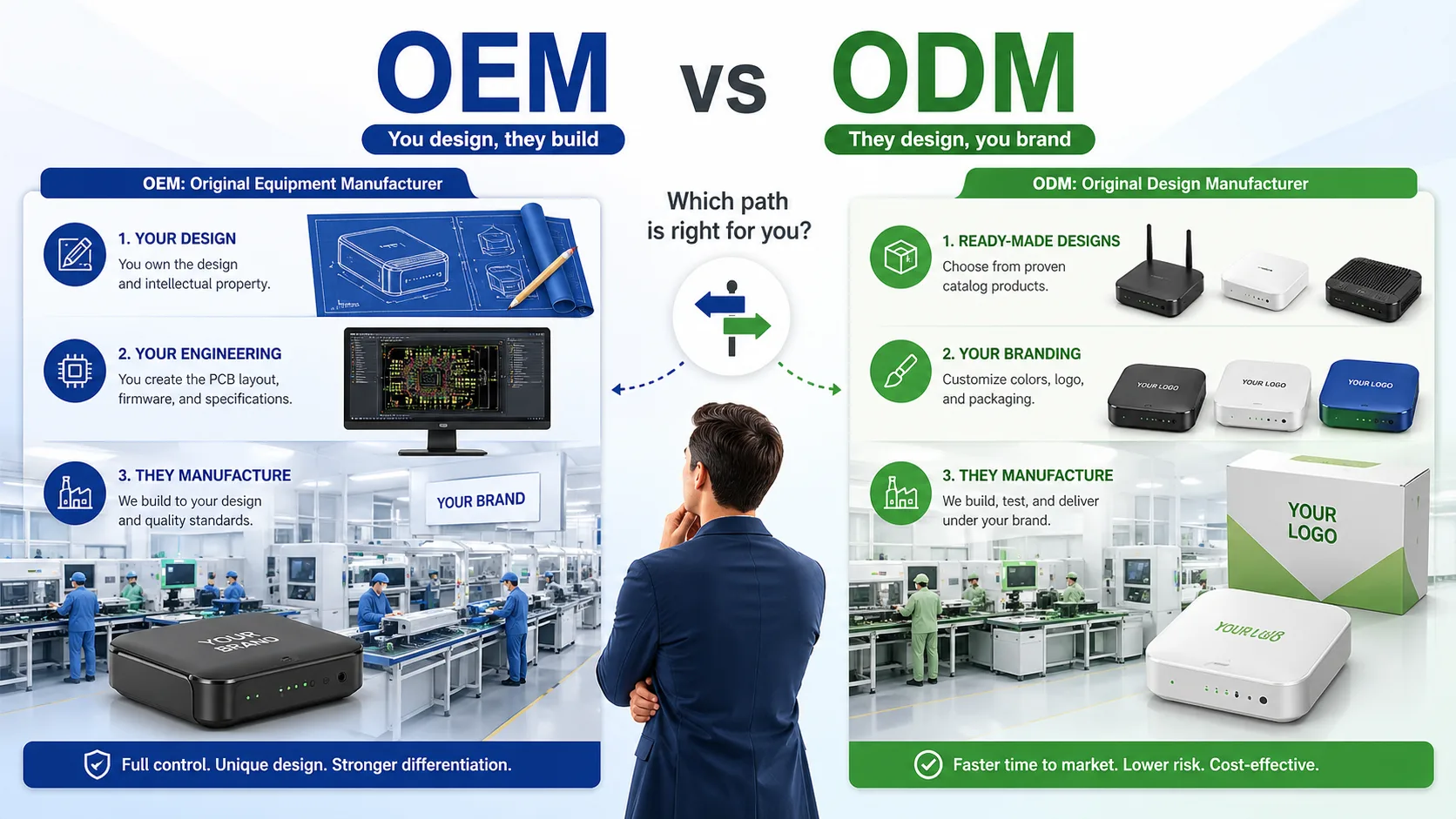
Let us skip the dictionary explanation. You can find "Original Equipment Manufacturer" and "Original Design Manufacturer" on Google. The more useful way to understand the difference is control.
- OEM means you design and the factory produces. The technical solution, drawings, firmware, and product logic are yours.
- ODM means the factory designs and you brand. The factory already has a mature solution, and you change the logo, color, shell, or some surface details.
With OEM, you give the factory your intellectual property and ask it to manufacture according to your specification. With ODM, the factory owns the intellectual property and you only use it for your brand.
At the beginning, this may not feel important. When the product starts to scale, it becomes a very different story.
The Hidden Risk of ODM Is Competing Against the Same Design
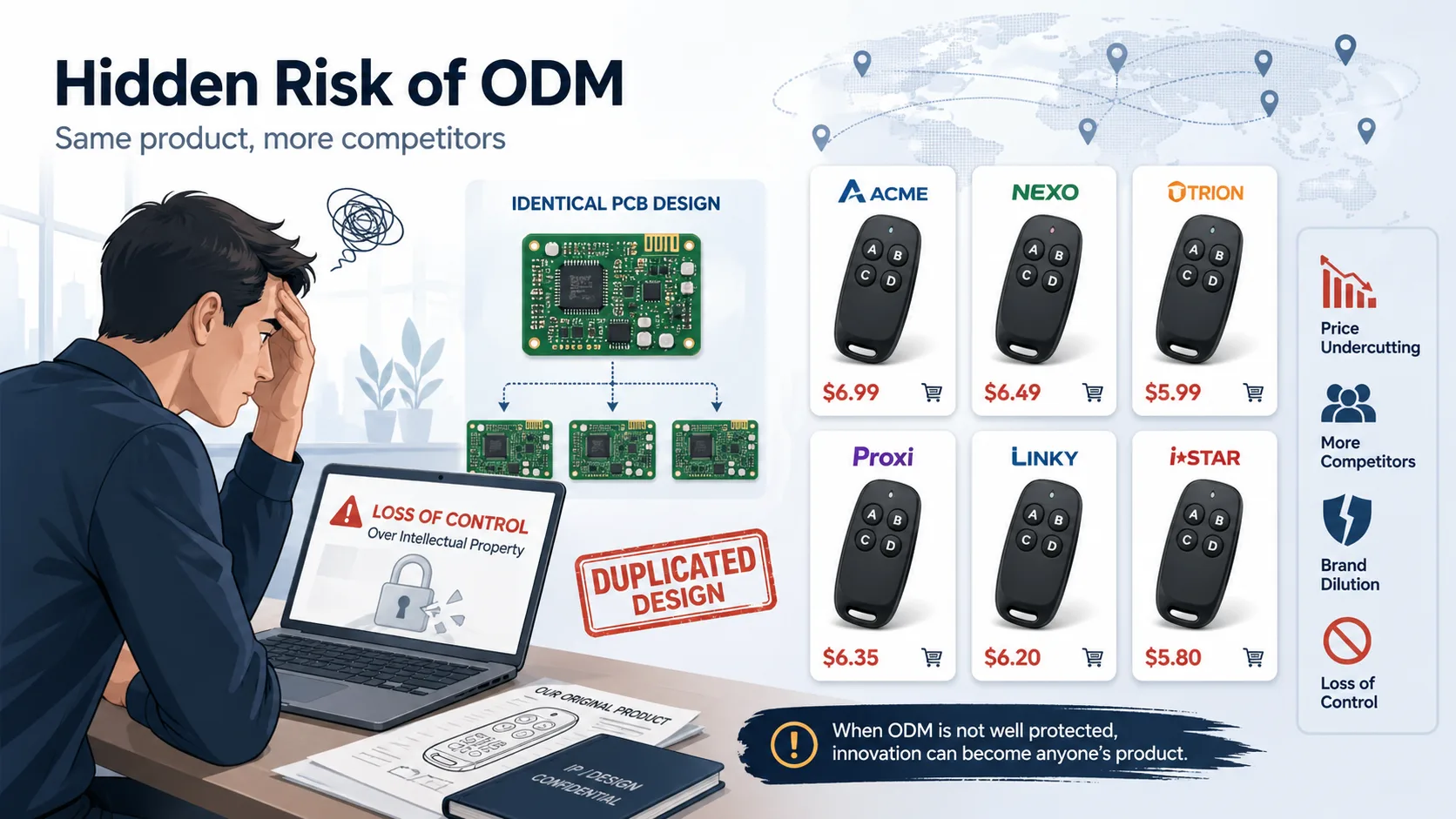
The reality is simple. You choose an RF remote control design from a factory, put your logo on it, and start selling. But because the design belongs to the factory, the same design can also be sold to other brands.
One year later, you may search online and find several similar remotes with the same PCB idea, the same basic function, and only a different shell or logo. Some may even be cheaper than yours.
What can you do? If you do not own the design, your legal and commercial position is weak. I have seen hardware startups lose in this way, not because their market idea was bad, but because the product was too easy to copy through the same supply chain.
RF Remotes Add One More Layer: Certification
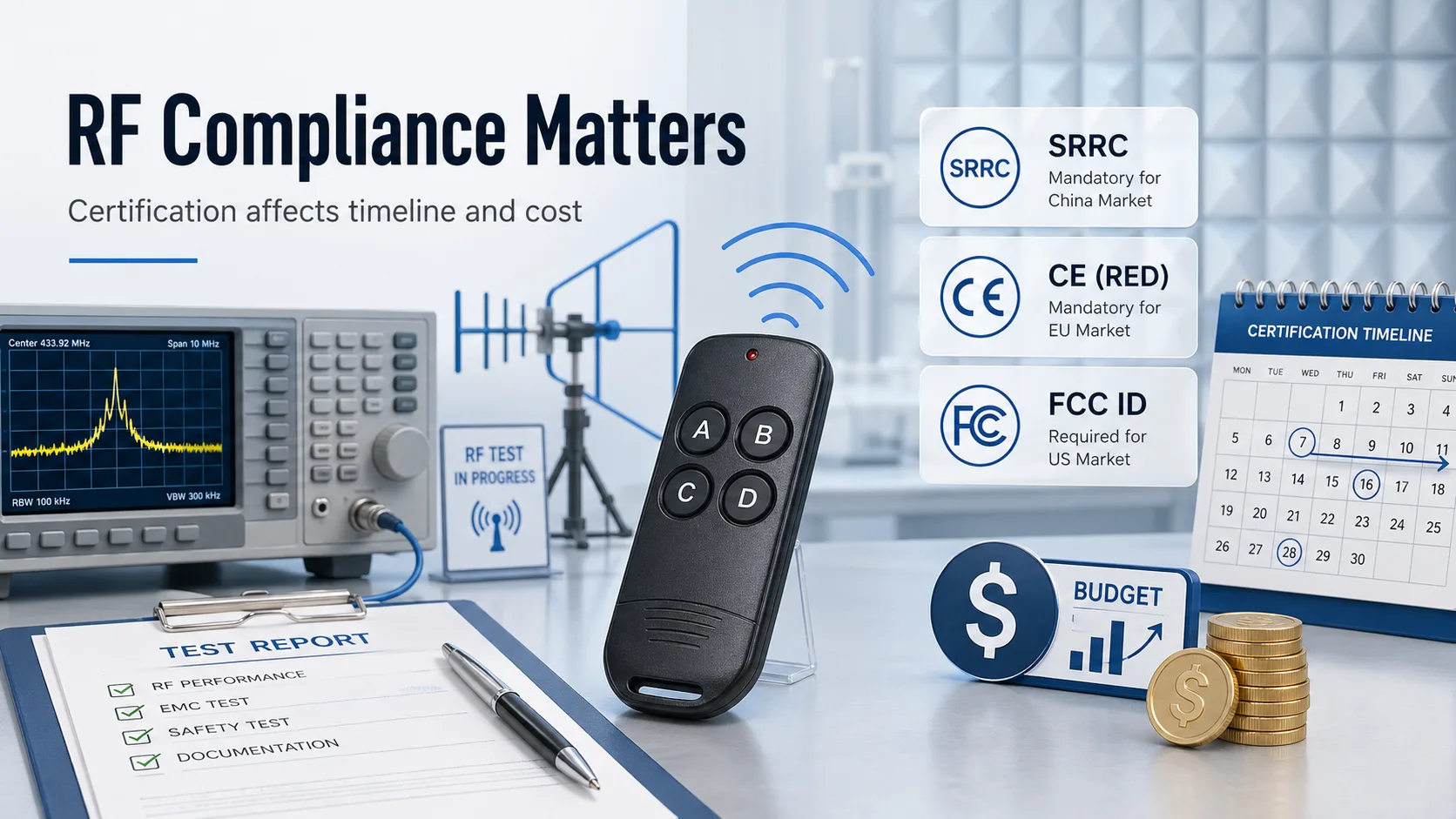
RF remotes are more complicated than many ordinary hardware products because they are wireless devices. A remote for a door, curtain, industrial controller, toy, or access system may need different certifications in different markets.
- China usually requires SRRC certification.
- Europe usually requires CE compliance under the RED Directive.
- The United States usually requires FCC approval for radio devices.
Certification can take months and cost thousands to tens of thousands, depending on the market and product. It is also tied to the hardware solution. If you change the antenna design, RF module, transmission power, or important radio structure, you may need to test again.
This is where ODM can be attractive. A mature factory solution may already have test experience or existing certification materials, which can save time. But OEM means you must plan certification yourself, including schedule, cost, test risk, and document preparation.
Fixed Code and Rolling Code Are Not Just Technical Details
One core technical choice in RF remotes is fixed code versus rolling code. This is not only an engineering detail. It affects security, market positioning, and whether the product is suitable for the application.
- Fixed code sends the same signal each time. It is simple and low cost, but older fixed-code remotes are easier to copy.
- Rolling code changes the signal each time. The transmitter and receiver use a synchronized logic, making copying much harder.
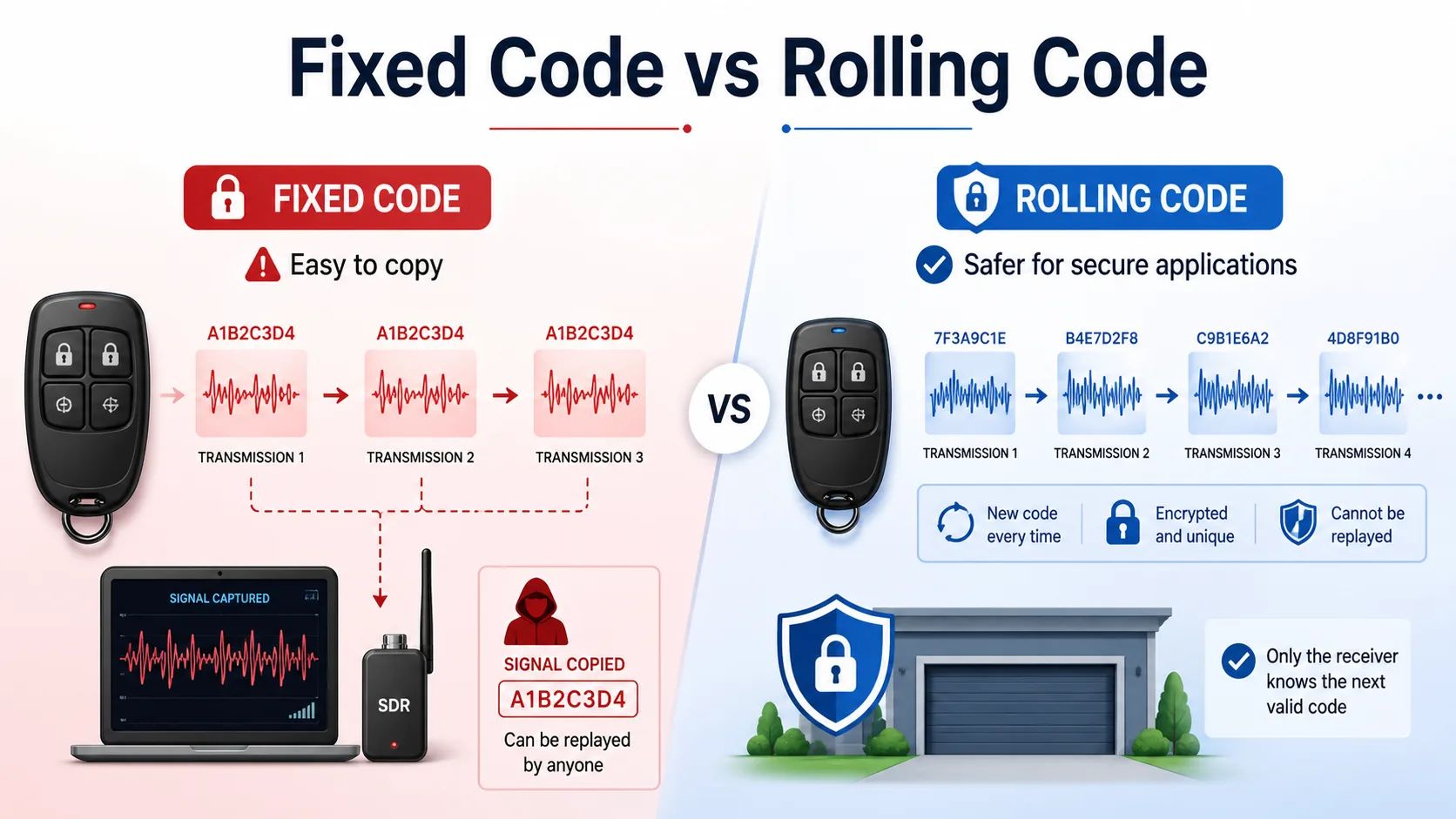
For secure applications such as door locks, garage doors, and access control, rolling code is often the better direction. The problem is that some ODM solutions still push fixed-code designs because they are mature, cheap, and easy to ship.
If the buyer does not understand the difference, they may choose a solution that looks fine in samples but becomes risky in real use.
Choose by Stage, Not by Vocabulary
There is no answer that fits every company. The right choice depends on your stage, your resources, your target market, and how much product control you need.
- If this is your first hardware project and you have no R&D team, ODM is usually the faster way to test the market.
- If the remote must work with your own receiver, platform, app, or protocol, OEM is usually necessary.
- If you need speed now but control later, start with ODM while developing your own OEM solution in parallel.
- If the product involves industrial safety, special regulations, or high-risk environments, OEM is usually the safer route.
For an ODM path, the contract should at least make component changes visible. If the factory changes the chip, RF module, antenna, or other key parts without telling you, your product quality and certification position may change without warning.
Do Not Use a Next-Stage Solution Too Early
Many teams fail not because they chose the wrong technology, but because they used a solution meant for another stage. If a small startup needs to ship in six months, full OEM development may slow everything down because R&D, tooling, testing, and certification all take time.
But if an ODM product is already selling well and competitors are copying the same factory design, staying with ODM for too long can also hurt the business.
Timing matters. The best solution is not the most advanced one. It is the one that fits your current stage and protects your next stage.
Supply Chain Sovereignty Is the Real Decision
Factory partners are important, but factories also have their own interests. Whoever owns the design and intellectual property has more power in the relationship.
With ODM, you give up some power in exchange for speed, lower development cost, and lower early risk. That can be a reasonable choice, but you should know what you are giving up and when you need to take it back.
Choosing OEM or ODM is not just a production decision. It is a decision about your future. Are you only putting new packaging on old logic, or are you clearly understanding your stage, your needs, and what you must control?
During RF remote control sourcing, smart home product development, or overseas hardware sales, what was your hardest OEM or ODM decision? Was it certification, fixed code versus rolling code, factory component changes, or losing uniqueness after the product started selling?
Feel free to share your thoughts in the comments. These real cases are often more useful than textbook definitions.

About the Author
Eric Huang
RF Remote Controls & Controllers Specialist
Hi, I'm Eric Huang, with 10+ years of experience in RF remote controls and controllers. I combine technical expertise with international trade knowledge to provide businesses with reliable, high-quality solutions. My goal is to ensure every client finds a trustworthy product.
Feel free to share your thoughts or ask questions. Let's connect!
Keep reading
Related articles
Circuits Don't Act: Why I Hate "Good Enough" Transmitter Modules More and More
A transmitter module is not reliable just because it can send a signal. Real quality depends on stability, clean output, tuning margin, and repeatable mass production.
Read next RF EngineeringRF Remote Concurrency and Collision Avoidance: From the Physical Layer to the Protocol Layer
When many RF remotes share the same channel, reliability depends on how the system handles shared spectrum, interference, timing, hidden terminals, acknowledgments, and recovery.
Read next OEM/ODMSame Shell, Same Product? The Hidden Downgrade in Electronics Manufacturing
Two remotes can share the same plastic shell but fail very differently because PCB material, component choices, SMT quality, conformal coating, and functional testing decide real product life.
Read nextPrecisa de ajuda agora?
Envie-nos sua pergunta de compatibilidade e responderemos diretamente.
Comments
Leave a comment or RF question
Share your unstable range, batch consistency, matching, filtering, case effect, or export production question. Eric will review the details and reply directly.
Comments are handled by email for now, so you can review the message before sending.