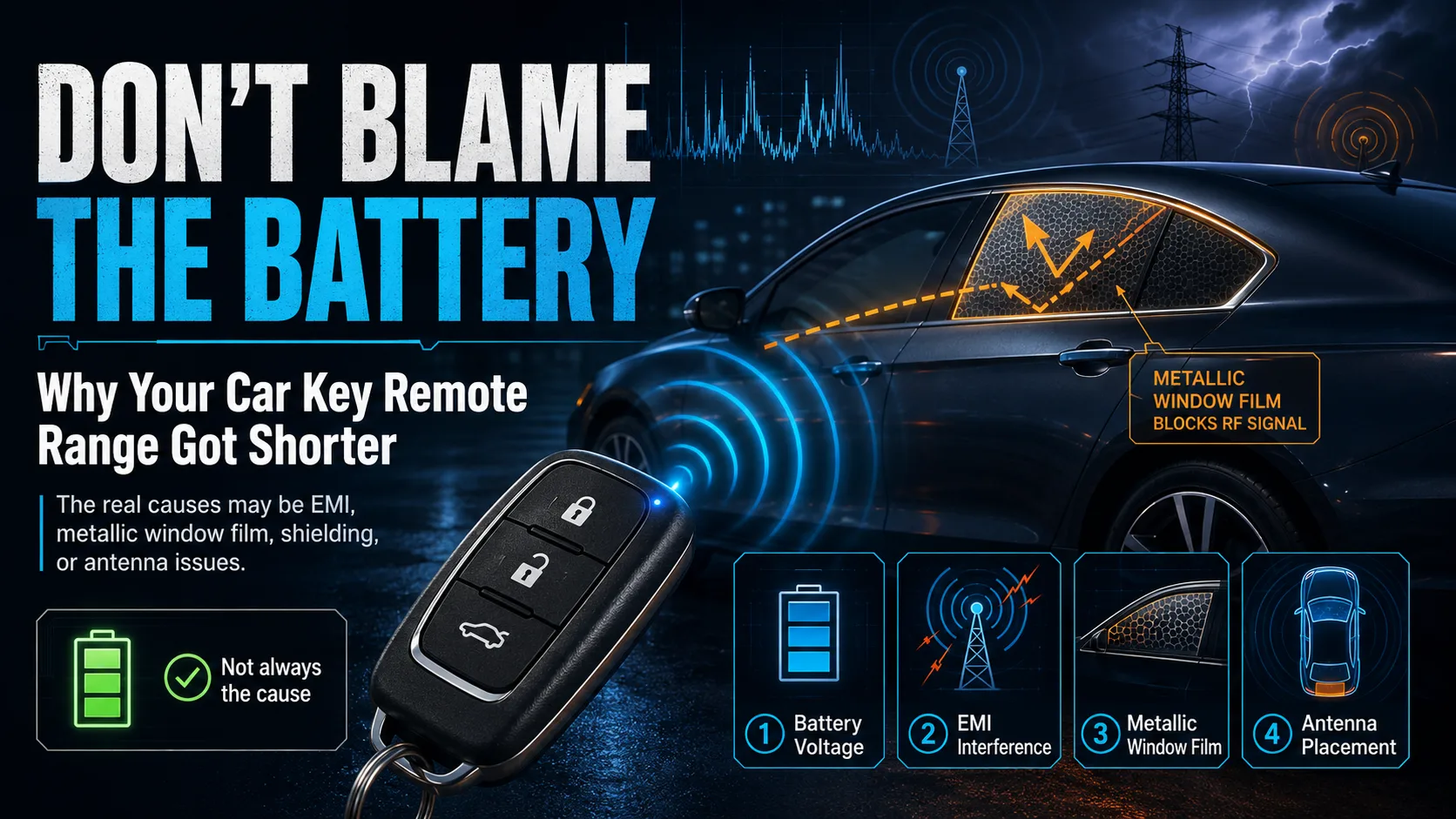
Car key remote short range is not always a weak coin cell. Metallic tint, same-frequency interference, metal key cases, rolling-code sync, and receiver antenna placement can all reduce usable range.
Reading mapArticle sections8 sections
I just replaced the coin cell in my car key. Now it barely works past five meters. Before, I could unlock the car from my fifth-floor balcony. What is going on?
A friend who runs a used car business sent me that message last week in a mild panic. He was convinced the key had been damaged in a drop.
Honestly, this is one of the most common complaints we hear around RF remote systems. Most people assume short range means a dead battery or a cheap remote.
In practice, it is usually a system-level problem. Battery, interference, shielding, antenna placement, and receiver behavior can all add up.
The Short Answer First
Short range on a car remote is not always caused by low battery charge.
The most common field checks are same-frequency interference around the parking environment, signal shielding from metallic window tint, metal key accessories, battery voltage under load, and receiver antenna placement in aftermarket systems.
Do Not Let a Bad Battery Be the Weakest Link
When range drops, many people grab the cheapest replacement coin cell from the nearest store. They swap it in and nothing improves.
That happens because some no-name batteries can still show a nominal 3V but have poor high-current discharge behavior. When you press the button, the RF circuit needs a short current burst to transmit properly.
If the battery internal resistance is high, voltage can sag during that burst. The indicator may still light, but transmit power can fall enough to reduce useful range.
- Use a known-brand coin cell instead of the cheapest replacement.
- Measure voltage under load when possible, not only open-circuit voltage.
- Clean oxidized battery contacts with a cotton swab and a small amount of alcohol.
- For aftermarket 433MHz remotes, use RF test equipment when available to confirm actual transmit power.
Same-Frequency Interference Is Often Overlooked
Many car remotes and aftermarket systems operate around 433.92MHz or 315MHz, depending on market and vehicle system. These bands are crowded in real environments.
Wireless cameras, LED signage drivers, low-quality EV chargers, switching power supplies, and cheap dashcam power adapters can all raise the local noise floor.
From the vehicle receiver point of view, the key signal may still be arriving. The problem is that the receiver cannot distinguish it clearly from the surrounding noise.
- Test the key in a different open location. If range returns, the original parking area likely has interference.
- Unplug dashcams, cigarette-lighter adapters, and aftermarket chargers one by one to see whether range improves.
- For product development, consider FSK modulation where the application and receiver architecture support it, because it can reject interference better than simple ASK designs.
- Check whether nearby LED signage or high-current equipment only runs at certain times of day.
Rolling-Code Sync Can Look Like a Range Problem
Modern car keys commonly use rolling code. The transmitted code changes with each press to reduce replay and cloning risk.
In real use, keys sometimes get pressed accidentally in a pocket or bag while the vehicle is far away. If the key counter advances too far without the receiver seeing those presses, the two sides can fall out of sync.
The symptom can feel like short range: the key only works very close to the car, or it needs repeated presses before the receiver accepts a command.
Do not open the key looking for a hardware fault first. Check the vehicle manual or service procedure for resynchronization. On the development side, the challenge is designing a practical acceptance window without weakening security.
Metallic Window Tint Can Block the Signal
This is the cause new car owners almost never suspect.
Metallic high-performance window tint can be excellent at blocking heat, but that same metallic layer can also reflect or attenuate RF signals.
A heavy zinc-alloy key case can create a similar problem from the transmitter side. Both act like partial shielding around the RF path.
- If range dropped after tinting, roll the window down and test again.
- If range improves with the window open, the film is part of the problem.
- Use ceramic film without a metallic layer when RF range matters.
- Avoid metal key fob cases if you want reliable distance. Leather or silicone is usually safer for RF performance.
The Receiver Antenna Can Be Buried
For factory vehicle systems, antenna design is usually integrated into the vehicle architecture. For aftermarket alarms, immobilizers, and receiver modules, installer placement can make or break range.
A receiver antenna stuffed deep into the dashboard, coiled up, or pressed against metal harnesses can lose sensitivity quickly.
The analogy is accurate: it is like trying to hear someone while pressing both hands over your ears.
- Pull the receiver antenna wire straight instead of leaving it coiled.
- Keep the antenna away from large metal structures and dense wiring harnesses.
- For aftermarket modules, place the antenna near the A-pillar or behind plastic trim near the top of the dashboard when practical.
- In product development, use network analyzer measurements to tune antenna matching and VSWR at the target frequency.
Certification and Consistency Matter More Than Brute Power
A lot of buyers evaluate RF modules by asking for a range demonstration. The sample performs impressively in an open field. Then the production batch goes into vehicles and complaints start.
One reason is that some low-cost suppliers push transmit power aggressively to win range tests. That can hurt battery life, increase emissions, and create compliance risk.
Stable range comes from receiver sensitivity, antenna design, frequency stability, and manufacturing consistency, not from simply forcing the transmitter louder.
- Verify regulatory documents for the target market, such as SRRC, FCC, CE-related conformity, or other local requirements.
- Ask about harmonics and spurious emissions, not only range.
- Check frequency drift across temperature, especially for modules used inside hot vehicles.
- Do not compare open-field demo range directly with real vehicle range through glass, tint, body metal, and parking-lot noise.
Quick Diagnostic Checklist
- Environment: is there a construction site, tower, LED sign, charger, or large metal structure nearby?
- Shielding: does the key have a metal case, or does the car have metallic window film?
- Battery: has voltage been checked under load, and are the contacts clean?
- Antenna: for aftermarket units, is the receiver antenna coiled or bundled with metal-heavy harnesses?
- Interference: does range improve after unplugging dashcams, USB chargers, or cigarette-lighter adapters?
- Sync: does the vehicle manual include a rolling-code resynchronization procedure?
Short range is almost never one thing. It is usually several small losses adding up.
If a case will not resolve, collect the facts before replacing parts: measured range versus target range, frequency, modulation, receiver module, antenna type, installation location, and certification status.
From there, it is usually clear whether antenna placement solves it, or whether the hardware needs a more serious review.

About the Author
Eric Huang
RF Remote Controls & Controllers Specialist
Hi, I'm Eric Huang, with 10+ years of experience in RF remote controls and controllers. I combine technical expertise with international trade knowledge to provide businesses with reliable, high-quality solutions. My goal is to ensure every client finds a trustworthy product.
Feel free to share your thoughts or ask questions. Let's connect!
Keep reading
Related articles
Same Batch of 433MHz Remotes: One Opens Instantly, One Plays Dead
When two identical 433MHz remotes behave differently on site, the fastest diagnosis starts with battery voltage under load, antenna placement, and electromagnetic interference.
Read next RF EngineeringYour Remote Control Has a Hearing Problem: How Receiver Sensitivity Decides RF Range
Receiver sensitivity is the spec that tells you how weak a signal the receiver can still decode, and it often matters more for usable RF range than louder transmit power.
Read next RF EngineeringHow Can a Single CR2032 Keep an RF Remote Running for Years?
A CR2032 can keep an RF remote alive for years only when the whole circuit treats standby current, RF pulses, GPIO leakage, LEDs, and wake-up timing as one fragile energy budget.
Read nextNecesita ayuda ahora?
Envenos su pregunta de compatibilidad y le responderemos directamente.
Comments
Leave a comment or RF question
Share your unstable range, batch consistency, matching, filtering, case effect, or export production question. Eric will review the details and reply directly.
Comments are handled by email for now, so you can review the message before sending.